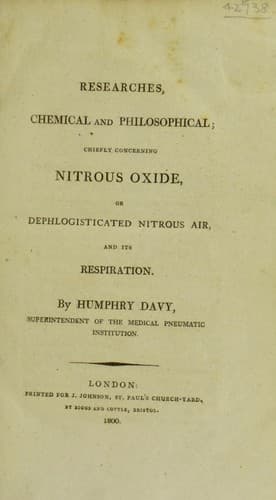
Researches Chemical and Philosophical; Chiefly concerning nitrous oxide: or dephlogisticated nitrous air and its respirationDavy, Humphry, Sir
Science
Researches Chemical and Philosophical; Chiefly concerning nitrous oxide: or dephlogisticated nitrous air and its respiration
Davy, Humphry, Sir
Nitrous oxide
In each of these experiments, the cylinder was covered with condensed
watry vapor exactly in the same manner as if common air had been
breathed in it. It ought to be observed that, E. 1. was made in the
morning, four hours and half after a moderate breakfast; whereas, E.
2. was made but an hour and quarter after a plentiful dinner; at which
near three fourths of a pint of table-beer had been drank.
From these experiments we learn, that nitrous oxide is rapidly
absorbed by the venous blood, through the moist coats of the pulmonary
veins. But as after a compleat voluntary exhaustion of the lungs,
much residual air must remain in the bronchial vessels and fauces,
as appears from their incapability of compleatly collapsing, it is
evident that the gas expired after every inspiration of nitrous oxide
mast be mingled with different quantities of the residual gas of the
lungs;[192] whilst after a complete expiration, much of the unabsorbed
nitrous oxide must remain as residual gas in the lungs. Now when
a complete expiration is made after the breathing of atmospheric
air, it is evident that the residual gas of the lungs consists of
nitrogene,[193] mingled with small portions of oxygene and carbonic
acid. And these are the only products found after the respiration of
nitrous oxide.
[192] By lungs, I mean in this place, all the internal organs of
respiration.
[193] Because these products are formed during the respiration of
common air.
To ascertain whether these products were partially produced, during
the process of respiration, as I was inclined to believe from the
experiments in the last section, or whether they were wholly the
residual gases of the lungs, I found extremely difficult.
I at first thought of breathing nitrous oxide immediately after my
lungs had been filled with oxygene; and to compare the products
remaining after the full expiration, with those produced after a full
expiration of pure oxygene; but on the supposition that oxygene and
nitrous oxide, when applied together to the venous blood, must effect
changes in it different from either of them separately, the idea was
relinquished.
I attempted to inspire nitrous oxide, after having made two
inspirations and a complete expiration of hydrogene; but in this
experiment the effects of the hydrogene were so debilitating, and the
consequent stimulation by the nitrous oxide so great, as to deprive
me of sense. After the first three inspirations, I lost all power of
standing, and fell on my back, carrying in my lips the mouth-piece
separated from the cylinder, to the great alarm of Mr. Patrick Dwyer,
who was noting the periods of inspiration.
Public-domain text, read in full here on John Shaqi.
Reviews
Reviews
No reviews yet
Be the first to share your thoughts on this work.
Elsewhere in the archive
Join the Discussion
Join the discussion
Sign in to leave a comment or review.
Sign InorCreate an account