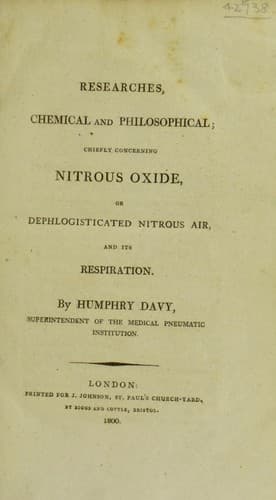
Researches Chemical and Philosophical; Chiefly concerning nitrous oxide: or dephlogisticated nitrous air and its respirationDavy, Humphry, Sir
Science
Researches Chemical and Philosophical; Chiefly concerning nitrous oxide: or dephlogisticated nitrous air and its respiration
Davy, Humphry, Sir
Nitrous oxide
It seems therefore reasonable to suppose, that the whole compound
atmospheric air passing through the moist coats of the vessels is first
dissolved by the serum of the venous blood, and in its condensed state,
decomposed by the affinity of the red particles for its oxygene; the
greater part of the nitrogene being liberated unaltered; but a minute
portion of it possibly remaining condensed in the serum and coagulable
lymph, and passing with them into the left chamber of the heart.
From the experiments on the respiration of nitrous oxide and hydrogene,
it appears that a certain portion of the carbonic acid produced in
respiration, is evolved from the venous blood; but as a much greater
quantity is generated during the respiration of common air and oxygene,
than during that of hydrogene in equal times, it is not impossible but
that some portion of it may be formed by the combination of charcoal in
the red particles with the oxygene dissolved in the serum; but this can
only be determined by farther experiments.
Supposing that no part of the water evolved in solution by the expired
gas of common air is formed immediately in respiration, it will follow
that a very considerable quantity of oxygene must be constantly
_combined_ with the red particles, even allowing the consumption of
a certain portion of it to form carbonic acid; for the carbonic acid
evolved, rarely amounts to more than three fourths of the volume of the
oxygene consumed.
Perhaps the serum of the blood is capable of dissolving a larger
quantity of atmospheric air than of pure oxygene. On this supposition,
it would be easy to explain the smaller consumption of oxygene in the
experiments in the last section.
IX. _Observations on the respiration of Nitrous Oxide._
The experiments in the first Division of this Research, prove that
nitrous oxide when respired by animals, produces peculiar changes in
their blood and in their organs, first connected with increased living
action; but terminating in death.
From the experiments in this Division, it appears, that nitrous oxide
is rapidly absorbed by the circulating venous blood, and of course its
condensed oxygene and nitrogene distributed in the blood over the whole
of the system.
Concerning the changes effected in the principles of the impregnated
blood during circulation and its action upon the nervous and muscular
fibre; it is useless to reason in the present state of our knowledge.
It would be easy to form theories referring the action of blood
impregnated with nitrous oxide, to its power of supplying the nervous
and muscular fibre with such proportions of condensed nitrogene,
oxygene and light or etherial fluid, as enabled them more rapidly
to pass through those changes which constitute their life: but such
theories would be only collections of terms derived from known
phænomena and applied by loose analogies of language to unknown things.
Public-domain text, read in full here on John Shaqi.
Reviews
Reviews
No reviews yet
Be the first to share your thoughts on this work.
Elsewhere in the archive
Join the Discussion
Join the discussion
Sign in to leave a comment or review.
Sign InorCreate an account