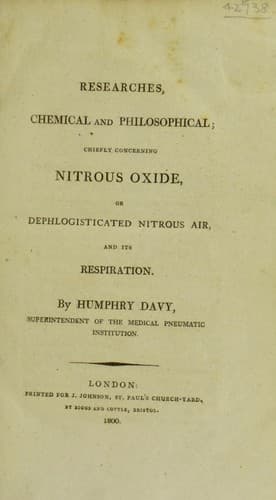
Researches Chemical and Philosophical; Chiefly concerning nitrous oxide: or dephlogisticated nitrous air and its respirationDavy, Humphry, Sir
Science
Researches Chemical and Philosophical; Chiefly concerning nitrous oxide: or dephlogisticated nitrous air and its respiration
Davy, Humphry, Sir
Nitrous oxide
I design very shortly, to repeat these experiments, and to make others
on the comparative consumption of oxygene and atmospheric air, by the
larger quadrupeds. Whatever may be the results, I hope to be able to
ascertain from them, why pure oxygene is incapable of supporting life.
VIII. _Observations on the changes effected in the blood, by
atmospheric air and oxygene._
From the experiments of Mr. Cigna and Dr. Priestley,[202] it appears
that the coagulum of the venous blood becomes florid at its surface
when exposed to the atmosphere, though covered and defended from the
immediate contact of air by a very thick stratum of serum.
[202] Dr. Priestley found that it likewise became florid at the surface
when covered by milk; but that it underwent little or no alteration of
color under water and most other fluids.—Vol. 3. p. 372.
Hence it is evident, that serum is capable of dissolving either the
whole compound atmospheric air, or the oxygene of it.
Supposing what indeed is most probable from numerous analogies, that
it dissolves the whole compound; it would follow, that the coloring
of the coagulum of blood under serum, depended upon the decomposition
of the atmospheric air condensed in the serum, the oxygene[203] of it
combining with the red particles, and the nitrogene either remaining
dissolved in the fluid, or being liberated through it into the
atmosphere.
Now the circulating blood consists of red particles, floating in and
diffused through serum and coagulable lymph.
[203] There are many analogous decompositions. Dr. Priestley noticed
(and I have often made the observation) that green oxide of iron, or
the precipitate from pale green sulphate of iron by caustic alkali,
became red at the surface, when covered by a thick stratum of water. In
my experiments on the green muriate and sulphate of iron, I observed
that part of some dark oxide of iron which was at the bottom of a
trough of water 9 inches deep, became red at the surface nearly in the
same time as another portion of the same precipitation that was exposed
to the atmosphere. This oxygenation must depend upon the decomposition
of atmospheric air constantly dissolved by the water.
In natural respiration, the red particles are rendered of a brighter
tinge during the passage of the blood through the pulmonary veins. And
as we have seen in the last sections, during respiration atmospheric
air is decomposed; all the oxygene of it consumed, _apparently_ a small
portion of the nitrogene lost, and a considerable quantity of carbonic
acid produced.
Public-domain text, read in full here on John Shaqi.
Reviews
Reviews
No reviews yet
Be the first to share your thoughts on this work.
Elsewhere in the archive
Join the Discussion
Join the discussion
Sign in to leave a comment or review.
Sign InorCreate an account