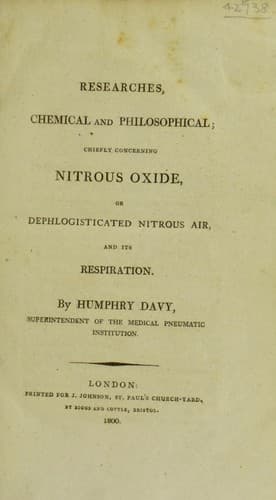
Researches Chemical and Philosophical; Chiefly concerning nitrous oxide: or dephlogisticated nitrous air and its respirationDavy, Humphry, Sir
Science
Researches Chemical and Philosophical; Chiefly concerning nitrous oxide: or dephlogisticated nitrous air and its respiration
Davy, Humphry, Sir
Nitrous oxide
I ought to have observed that a desire to breathe the gas is always
awakened in me by the sight of a person breathing, or even by that of
an air-bag or an airholder.
I have this day, June 5th, respired four large doses of gas. The
first two taken in the morning acted very powerfully; but produced
no thrilling or other pleasurable feelings. The effects of the third
breathed immediately after a hearty dinner were pleasant, but neither
intense or intoxicating. The fourth was respired at night in darkness
and silence after the occurrence of a circumstance which had produced
some anxiety. This dose affected me powerfully and pleasantly; a slight
thrilling in the extremities was produced; an exhiliration continued
for some time, and I have had but little return of uneasiness. 11 P. M.
From the nature of the language of feeling, the preceding detail
contains many imperfections; I have endeavoured to give as accurate an
account as possible of the strange effects of nitrous oxide, by making
use of terms standing for the most similar common feelings.
We are incapable of recollecting pleasures and pains of sense.[220] It
is impossible to reason concerning them, except by means of terms which
have been associated with them at the moment of their existence, and
which are afterwards called up amidst trains of concomitant ideas.
[220] Physical pleasure and pain generally occur connected with a
compound impression, i. e. an organ and some object. When the idea left
by the compound impression, is called up by being linked accidentally
to some other idea or impression, no recurrence, or the slightest
possible, of the pleasure or pain in any form will take place. But when
the compound impression itself exists _without_ the physical pleasure
or pain, it will awaken ideal or intellectual pleasure or pain, i. e.
hope or fear. So that physical pleasure and pain are to hope and fear,
what impressions are to ideas. For instance, assuming no accidental
association, the child does not fear the fire before he is burnt. When
he puts his finger to the fire he feels the physical pain of burning,
which is connected with a visible compound impression, the fire and his
finger. Now when the compound idea of the fire and his finger, left
by the compound impression are called up by his mother, saying, “_You
have burnt your finger_,” nothing like fear or the pain of burning is
connected with it. But when the finger is brought near the fire, i. e.
when the compound impression again exists, the ideal pain of burning or
the passion of fear is awakened, and it becomes connected with those
very actions which removed the finger from the fire.
When pleasures and pains are new or connected with new ideas, they can
never be intelligibly detailed unless associated during their existence
with terms standing for analogous feelings.
Public-domain text, read in full here on John Shaqi.
Reviews
Reviews
No reviews yet
Be the first to share your thoughts on this work.
Elsewhere in the archive
Join the Discussion
Join the discussion
Sign in to leave a comment or review.
Sign InorCreate an account