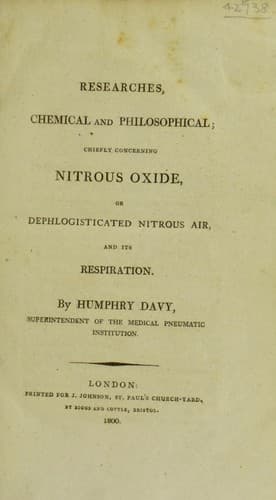
Researches Chemical and Philosophical; Chiefly concerning nitrous oxide: or dephlogisticated nitrous air and its respirationDavy, Humphry, Sir
Science
Researches Chemical and Philosophical; Chiefly concerning nitrous oxide: or dephlogisticated nitrous air and its respiration
Davy, Humphry, Sir
Nitrous oxide
[228] See Dr. Beddoes’s _Considerations_, _part_ 1. _page_ 26. His
observations in the note in the last section, will likewise apply
here.—Is not healthy living action dependant upon a certain equilibrium
between the principles supplied to the blood by the pulmonary veins
from respiration and by the lymphatics from absorption? Does not
sensibility more immediately depend upon respiration? Deprive an
animal under stimulation, of air, and it instantly dies; probably if
absorption could be prevented, it would likewise speedily die. It would
be curious to try whether intoxication from fermented liquors cannot be
prevented by breathing during their operation, an atmosphere deprived
of part of its oxygene.
By this oxygene and nutritive matter excitability may be kept up: and
exhaustion consequent to excitement only produced, in consequence of a
deficiency of some of the nutritive principles, which are supplied by
absorption.
When nitrous oxide is breathed, nitrogene (a principle under common
circumstances chiefly carried into the blood by the absorbents in fluid
compounds) is supplied in respiration; a greater quantity of oxygene
is combined with the blood than in common respiration, whilst less
carbonic acid and probably less water are evolved.
Hence a smaller quantity of nutritive matter is probably required from
the absorbents during the excitement from nitrous oxide, than during
the operation of stimulants; and in consequence, exhaustion from the
expenditure of nutritive matter more seldom occasioned.
Since Research III. has been printed, I have endeavoured to ascertain
the quantities of nitrogene produced when nitrous oxide is respired
for a considerable time. In one experiment, when I breathed about four
quarts of gas in a glass bell over impregnated water for near a minute,
it was diminished to about two quarts; and the residuum extinguished
flame.
Now the experiments in Research II. prove that when nitrous oxide is
decomposed by combustible bodies, the quantity of nitrogene evolved is
rather greater in volume than the pre-existing nitrous oxide. Hence
much of the nitrogene taken into the system during the respiration of
nitrous oxide, must be either carried into new combinations, or given
out by the capillary vessels through the skin.
It would be curious to ascertain whether the quantity of ammoniac in
the saline matters held in solution by the secreted fluids is increased
after the respiration of nitrous oxide. Experiments made upon the
consumption of nitrous oxide mingled with atmospheric air by the
smaller animals, would go far to determine whether any nitrogene is
given out through the skin.
The various effects of nitrous oxide upon different individuals and
upon the same individuals at different times, prove that its powers are
capable of being modified both by the peculiar condition of organs, and
by the state of general feeling.
Public-domain text, read in full here on John Shaqi.
Reviews
Reviews
No reviews yet
Be the first to share your thoughts on this work.
Elsewhere in the archive
Join the Discussion
Join the discussion
Sign in to leave a comment or review.
Sign InorCreate an account