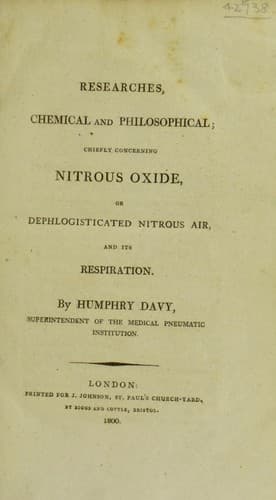
Researches Chemical and Philosophical; Chiefly concerning nitrous oxide: or dephlogisticated nitrous air and its respirationDavy, Humphry, Sir
Science
Researches Chemical and Philosophical; Chiefly concerning nitrous oxide: or dephlogisticated nitrous air and its respiration
Davy, Humphry, Sir
Nitrous oxide
Reasoning from common phænomena of sensation, particularly those
relating to heat, it is probable that pleasurable feeling is uniformly
connected with a moderate increase of nervous action; and that this
increase when carried to certain limits, produces mixed emotion or
sublime pleasure; and beyond those limits occasions absolute pain.
Comparing the facts in the last division, it is likely that individuals
possessed of high health and little sensibility, will generally be
less pleasurably affected by nitrous oxide than such as have more
sensibility, in whom the emotions will sometimes so far enter the
limits of pain as to become sublime;[229] whilst the nervous action in
such as have exquisite sensibility, will be so much increased as often
to produce disagreeable feeling.
Modification of the powers of nitrous oxide by mixture of the gas
with oxygene or common air, will probably enable the most delicately
sensible to respire it without danger, and even with pleasurable
effects: heretofore it has been administered to such only in its pure
form or mingled with small quantities of atmospheric air, and in its
pure form even the most robust are unable to respire it with safety for
more than five minutes.
[229] Sublime emotion with regard to natural objects, is generally
produced by the connection of the pleasure of beauty with the passion
of fear.
The muscular actions[230] sometimes connected with the feelings
produced by nitrous oxide, seem to depend in a great measure upon the
particular habits of the individual; they will usually be of that kind
which is produced either by common pleasurable feelings or strong
emotions.
[230] The immortal HARTLEY has demonstrated that all our motions are
originally automatic, and generally produced by the action of tangible
things on the muscular fibre.
The common actions of adults may be distinguished into two kinds;
voluntary actions, and mixed automatic actions. The first are
produced by ideas, or by ideas connected with passions. The second by
impression, or by pleasure and pain.
In voluntary action, regular associations of ideas and muscular motions
exist: as when a chemist performs a pre-conceived experiment.
In mixed automatic actions, the simple motions produced by impression
are connected with series of motions formerly voluntary, but now
produced without the intervention of ideas: as when a person
accustomed to play on the harpsichord, from accidentally striking
a key, is induced to perform the series of motions which produce a
well-remembered tune.
Evidently the muscular actions produced by nitrous oxide are mixed
automatic motions.
Hysterical affection is occasioned by nitrous oxide, probably only in
consequence of the strong emotion produced, which destroys the power of
the will, and calls up series of automatic motions formerly connected
with a variety of less powerful but similar feelings.
Public-domain text, read in full here on John Shaqi.
Reviews
Reviews
No reviews yet
Be the first to share your thoughts on this work.
Elsewhere in the archive
Join the Discussion
Join the discussion
Sign in to leave a comment or review.
Sign InorCreate an account