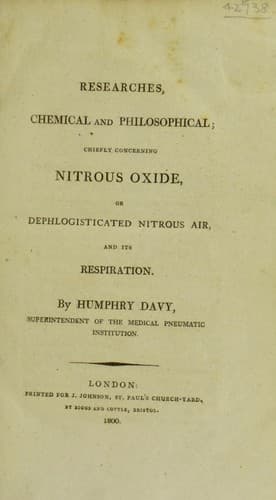
Researches Chemical and Philosophical; Chiefly concerning nitrous oxide: or dephlogisticated nitrous air and its respirationDavy, Humphry, Sir
Science
Researches Chemical and Philosophical; Chiefly concerning nitrous oxide: or dephlogisticated nitrous air and its respiration
Davy, Humphry, Sir
Nitrous oxide
I introduced through water into six phials, one of which contained
hydrogene, one oxygene, one common air, one hydrocarbonate, one
carbonic acid, and one nitrous oxide, six similar plants of mint,
their roots being in contact with water and their leaves exposed to
light.
The plant in carbonic acid began to fade in less than two days, and
in four was dead. That in hydrogene died in less than five days; that
in nitrous oxide did not fade much for the first two days, but on
the third, drooped very much, and was dead at the same time as that
in hydrogene. The plant in oxygene for the first four days, looked
flourishing and was certainly of a finer green than before, gradually
however, its leaves became spotted with black and dropped off one by
one, till at the end of ten days they had all disappeared. At this
time the plant in common air looked sickly and yellow, whilst that in
hydrocarbonate was greener and more flourishing than ever.
I have detailed these experiments not on account of any important
conclusions that may be drawn from them; but with a view of inducing
others to repeat them, and to examine the changes effected in the
gases. If it should be found by future experiments, that hydrocarbonate
generally increased vegetation, it would throw some light upon the use
of manures, containing putrefying animal and vegetable substances, from
which this gas is perpetually evolved.
The chemistry of vegetation though immediately connected with
agriculture, the art on which we depend for subsistence, has been but
little investigated. The discoveries of Priestley and Ingenhousz, seem
to prove that it is within the reach of our instruments of experiment.
No. II.
APPROXIMATIONS TO THE _Composition and Weight of the aëriform_
_COMBINATIONS of NITROGENE_
At temperature 55°, and atmospheric pressure 30.
Public-domain text, read in full here on John Shaqi.
Reviews
Reviews
No reviews yet
Be the first to share your thoughts on this work.
Elsewhere in the archive
Join the Discussion
Join the discussion
Sign in to leave a comment or review.
Sign InorCreate an account