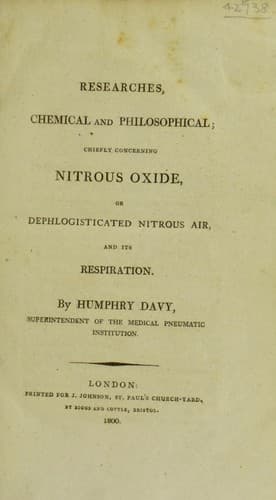
Researches Chemical and Philosophical; Chiefly concerning nitrous oxide: or dephlogisticated nitrous air and its respirationDavy, Humphry, Sir
Science
Researches Chemical and Philosophical; Chiefly concerning nitrous oxide: or dephlogisticated nitrous air and its respiration
Davy, Humphry, Sir
Nitrous oxide
[234] Supposing the increase or diminution of living action when
produced by different agents, uniform, similar and differing only in
degree; it would follow, that certain mixtures of hydrocarbonate and
nitrous oxide, or hydrogene and nitrous oxide, ought to be capable of
supporting the life of animals for a much longer time than pure nitrous
oxide. From the experiments in Res. III. Div. I. it appears however,
that this is not the case.
It would seem, that in life, a variety of different corpuscular changes
are capable of producing phænomena apparently similar; so that in the
science of living action, we are incapable of reasoning concerning
causes from effects.
Whenever we attempt to combine our scattered physiological facts, we
are stopped by the want of numerous intermediate analogies; and so
loosely connected or so independant of each other, are the different
series of phænomena, that we are rarely able to make probable
conjectures, much less certain predictions concerning the results of
new experiments.
An immense mass of pneumatological, chemical, and medical information
must be collected, before we shall be able to operate with certainty,
on the human constitution.
Pneumatic chemistry in its application to medicine, is an art in
infancy, weak, almost useless, but apparently possessed of capabilities
of improvement. To be rendered strong and mature, she must be
nourished by facts, strengthened by exercise, and cautiously directed
in the application of her powers by rational scepticism.
APPENDIX.
No. I.
_Effects of Nitrous Oxide on Vegetation._
In July 1799, I introduced two small plants of spurge into nitrous
oxide, in contact with a little water over mercury; after remaining
in it two days, they preserved their healthy appearance, and I could
not perceive that any gas had been absorbed. I was prevented by an
accident, from keeping them longer in the gas.
A small plant of mint introduced into nitrous oxide and exposed to
light, in three days became dark olive and spotted with brown; and in
about six days was quite dead.—Another similar plant, kept in the dark
in nitrous oxide, did not alter in color for five days, and at the end
of seven days, was only a little yellower than before. I could not
ascertain whether any gas had been absorbed.
I introduced into nitrous oxide through water, a healthy budding rose,
thinking that its colors might be rendered brighter by the gas. I was
disappointed, it very speedily faded and died; possibly injured by the
solution of nitrous oxide in water.
Of two rows of peas just appearing above ground; I watered one with
solution of nitrous oxide in water, and the other with common water
daily, for a fortnight. At the end of this time, I could perceive no
difference in their growth, and afterwards they continued to grow
equally fast.
Public-domain text, read in full here on John Shaqi.
Reviews
Reviews
No reviews yet
Be the first to share your thoughts on this work.
Elsewhere in the archive
Join the Discussion
Join the discussion
Sign in to leave a comment or review.
Sign InorCreate an account