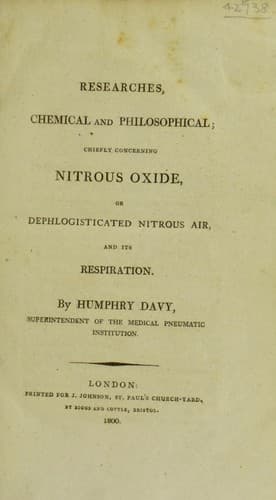
Researches Chemical and Philosophical; Chiefly concerning nitrous oxide: or dephlogisticated nitrous air and its respirationDavy, Humphry, Sir
Science
Researches Chemical and Philosophical; Chiefly concerning nitrous oxide: or dephlogisticated nitrous air and its respiration
Davy, Humphry, Sir
Nitrous oxide
About a fortnight ago, I respired, after forced voluntary exhaustion of
my lungs, my nose being accurately closed, three quarts of hydrogene in
a silk bag, at four intervals, for near five minutes. After this it was
highly inflammable, and burnt with a greenish white flame in contact
with the atmosphere; but was not so explosive as before.[237]
[237] If loosely combined carbon exists in venous blood, hydrogene may
probably dissolve a portion of it when respired and become slightly
carbonated. At least there is as much probability in the supposition
that carbon in loose affinity may combine with hydrogene at 98° as that
it may combine with oxygene.
_c._ From what we have lately heard of the curious experiments of Mr.
Volta and Mr. Carlisle, it is very probable that the conversion of
nitrous gas into nitrous oxide when exposed to wetted zinc, copper
and tin, in contact with mercury, as described in Res. I. Div. V. may
in some measure depend on the action of the galvanic fluid. Whilst I
was engaged in the experiments on this conversion, Dr. Beddoes[238]
mentioned to me some curious facts noticed by Humboldt and Ritter,
relating to the oxydation of metals by the decomposition of water,
which induced me to examine the phænomena with more attention than I
should have otherwise done.—I recollect observing that some of the
wetted zinc filings in nitrous gas on the side of the jar not in
contact with the surface of mercury, were very slowly oxydated. Whilst
on the surface of the mercury where small globules of that substance
were mingled with the filings of zinc, the decomposition went on much
more rapidly; possibly through the medium of the moisture, a series of
galvanic circles were formed.
[238] Dr. BEDDOES has since favoured me with the following account of
these facts.
“Mr. Humboldt (ueber die gereizte Faser I. 473, 1797) quotes part of a
letter from Dr. Ash, in which it is said that _if two finely polished
plates of homogeneous zinc be moistened and laid together, little
effect follows—but if zinc and silver be tried in the same way, the
whole surface of the silver will be covered with oxydated zinc. Lead
and quicksilver act as powerfully on each other, and so do iron and
copper._—Mr. Humboldt (p. 474) says that, in repeating this experiment,
he saw air-bubbles ascend, which he supposes to have been hydrogene gas
from the decomposition of water—When he placed zinc simply on moist
glass, the same phænomena took place, but more slowly and later. The
quantity of oxyd of zinc upon the glass alone was in 20 hours to that
on the silver as one to three.
Public-domain text, read in full here on John Shaqi.
Reviews
Reviews
No reviews yet
Be the first to share your thoughts on this work.
Elsewhere in the archive
Join the Discussion
Join the discussion
Sign in to leave a comment or review.
Sign InorCreate an account