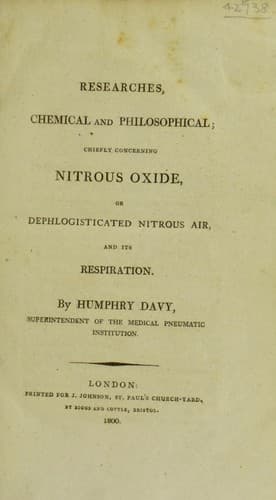
Researches Chemical and Philosophical; Chiefly concerning nitrous oxide: or dephlogisticated nitrous air and its respirationDavy, Humphry, Sir
Science
Researches Chemical and Philosophical; Chiefly concerning nitrous oxide: or dephlogisticated nitrous air and its respiration
Davy, Humphry, Sir
Nitrous oxide
In a very ingenious but obscurely written tract by Mr. Ritter,
entitled, _Evidence that the galvanic action exists in organic nature_,
_8vo. Jena, 1800_—The author observes, that the care of Dr. Ash and
Mr. Humboldt that the metals should touch each other in as many points
as possible was superfluous, even if we could grant that two metallic
plates might be made by polishing, to touch in a number of points.
To shew that it was sufficient if by touching in one point only they
should form a compleat galvanic circle, he dropped a single drop of
distilled water upon the bust of a large silver coin. A piece of pure
zinc was placed with its one end on the edge of the coin, while the
other was supported by a bit of glass. The drop of water was neither in
contact with the glass nor with the point at which the metals touched.
The materials were left in this situation for four hours at the
temperature of 68°. On taking them apart, the water had become quite
milky and had half disappeared; and Mr. Ritter actually separated a
quantity of white oxide that had been produced in the experiment.
The pieces of metal were cleaned and laid together in the same manner,
only that now a piece of paper was put between the metals at their
former point of contact. In four hours first, and afterwards in ten, a
faint ring of oxide only had been produced of which the quantity could
not be estimated, nor could it be separated. In this case, the zinc
had scarce lost any thing of its splendour; in the former it had been
corroded. In many repetitions of the experiment, he found that far more
oxide was formed when the metals touched, than when they were separated
to the slightest distance by an insolating body, even air.
On exposing these apparatuses with somewhat more water to a
considerable heat for four minutes, the water in the interrupted circle
continued quite clear, while that in the other had become milk-white.
The same phænomena were presented by other pairs of metals in a degree
proportional to their galvanic activity; viz. by zinc and molybdæna,
zinc and bismuth, zinc and copper, as also with tin and silver, tin
and molybdæna, and lead and silver. The experiment with tin was
particularly decisive, for when in contact with no other metal it was
scarcely at all oxydated by water, though oxydation took place when tin
was brought into contact with silver, and both were connected at the
other end by a drop of water—What therefore took place in Dr. Ash’s
experiment, arose from an aggregation of galvanic circles of different
forms.
Public-domain text, read in full here on John Shaqi.
Reviews
Reviews
No reviews yet
Be the first to share your thoughts on this work.
Elsewhere in the archive
Join the Discussion
Join the discussion
Sign in to leave a comment or review.
Sign InorCreate an account