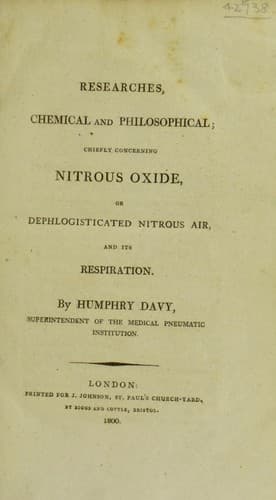
Researches Chemical and Philosophical; Chiefly concerning nitrous oxide: or dephlogisticated nitrous air and its respirationDavy, Humphry, Sir
Science
Researches Chemical and Philosophical; Chiefly concerning nitrous oxide: or dephlogisticated nitrous air and its respiration
Davy, Humphry, Sir
Nitrous oxide
Having loaded the receiver with the weight I, something heavier than
may be necessary to force it through the mercury, it is balanced by
the small weight K, which hangs from that part of the spiral where the
radius is equal to that of the wheel G, from this point the radius
of the spiral must be increased in such proportion, that in every
part of its circuit, the weight K may be an exact counterpoise to the
airholder. In this way, so little friction will be produced, that
merely plunging the lower orifice of the tube D under mercury contained
in the small vessel L, will be sufficient to overcome every resistance,
and to force the gas discharged from the beak of a retort into the
receiver, where whatever may be its quantity, it will be subjected to
a pressure exactly corresponding to that of the atmosphere. The edge
of the wheel H being graduated, the balance cord _c_ may be made to
indicate its volume.
Should it at any time be necessary to reduce the pressure to the medium
standard of the barometer, it may easily be done by graduating the
lower end of the tube D, and adding to the weights I or K, as may be
found necessary; the surface of the mercury in the tube pointing out
the increase or diminution.
The concavity at the top of the internal cylinder is intended to
contain any liquid it may be thought proper to expose to the action of
the gas.
The upper orifice _f_, with its ground stopper, is particularly useful
in conveying air from the retort _g_, with its curved neck, into the
receiver, without its passing through the tube D. In all cases where a
rapid extrication of gas is expected the retort _g_, should be firmly
luted to the orifice and the weight I, removed from the top of the
receiver, this by diminishing the pressure, will admit the gas to
expand freely in the airholder at the instant of its formation, and
prevent an explosion of the vessels. The same caution must be observed
whenever any inflammation of gas is produced by the electric spark.
The air may be readily transferred through water or even mercury by the
tube _h_, Fig. 1.
To prevent an absorption of mercury in case of a condensation taking
place in the retort made use of for generating air, Mr. Davy has
applied the stop-cock _i_, to which the neck is firmly luted. This
stop-cock is likewise of great service in saturating water with acid or
alkaline gases, which may be effected by luting one end of the tube _k_
to the stop-cock, and plunging the other into the fluid in the small
vessel _l_, cemented at top, and terminating in the bent funnel _m_—the
tube _h_ having been previously removed, and the lower orifice of the
tube D either sunk to a considerable depth in mercury, or closed with a
ground stopper. The bend of the funnel _m_, may be accurately closed by
the introduction of a few lines of mercury.
The application of the stop-cock _n_, has enabled Mr. Davy to perform
some experiments on respiration with considerable accuracy.
Public-domain text, read in full here on John Shaqi.
Reviews
Reviews
No reviews yet
Be the first to share your thoughts on this work.
Elsewhere in the archive
Join the Discussion
Join the discussion
Sign in to leave a comment or review.
Sign InorCreate an account