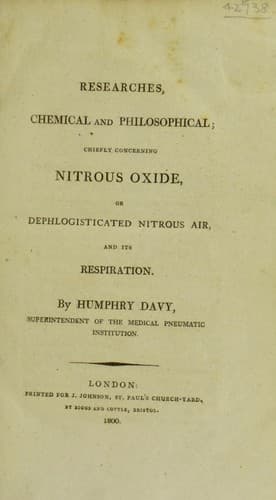
Researches Chemical and Philosophical; Chiefly concerning nitrous oxide: or dephlogisticated nitrous air and its respirationDavy, Humphry, Sir
Science
Researches Chemical and Philosophical; Chiefly concerning nitrous oxide: or dephlogisticated nitrous air and its respiration
Davy, Humphry, Sir
Nitrous oxide
By the foregoing experiments, concludes Mr. Ritter, which though
capable of the most various modifications, uniformly coincide in
their main result, it is abundantly proved that _galvanic circles
can be formed of merely inorganic bodies, by whose completion there
is produced an action which ceases when the circle is opened_. The
manner in which this has been shewn, proves also that _this action can
effectuate sensible modifications in organic bodies_; and the process
by which these modifications have been effected, made it evident that
they _were not consequences of a momentary action of the circle, but
of an action that is kept up while the circle remains entire_; for the
process which brought this action under the cognizance of the senses
went on, while the circle was unbroken, and its figure not brought back
to that of a line.
It is scarce necessary to observe that the experiments here quoted, are
far from being the only ones on which the above conclusions rest.”
_T. B._
_d._ In Res. II. Div. I. it is stated, that nitrous oxide during its
solution by common water, expels about ¹/₁₆ of atmospheric air the
volume of the water being unity.
From the delicate experiments of Dr. Pearson, on the passage of the
electric spark through water, it appears however probable, that much
more than ¹/₁₆ of atmospheric air is sometimes held in solution by that
fluid,[239] possibly the whole of the air is not expelled by nitrous
oxide, owing to some unknown law of saturation by which an equilibrium
of affinity is produced, forming a triple compound.
[239] Possibly a ratio exists between the solubility of gases in water,
and the solubility of water in gases. It is probable from Mr. Wm.
Henry’s curious experiments on the muriatic acid, that the absolute
quantity of water in _many_ gases, may be ascertained by means of its
decomposition by the electric spark.
No. IV.
DESCRIPTION OF A MERCURIAL AIRHOLDER.
Suggested by an inspection of Mr. WATT’S Machine for containing
Factitious Airs.
_By WILLIAM CLAYFIELD_.
Several modes of counteracting the pressure of a decreasing column of
mercury having been thought of in conjunction with Mr. W. Cox, the
following was at last adopted as the most simple and effectual.
Plate 1 Fig. 1, represents a section of the machine, which consists of
a strong glass cylinder A cemented to one of the same kind B, fitted
to the solid block C, into which the glass tube D is cemented for
conveying air into the moveable receiver E.
The brass axis F, Fig. 2, having a double bearing at _a_, _a_, is
terminated at one end by the wheel G, the circumference of which is
equal to the depth of the receiver, so that it may be drawn to the
surface of the mercury by the cord _b_ in one revolution; to the other
end is fitted the wheel H, over which the balance cord _c_ runs in an
opposite direction in the spiral groove _e_, a front view of the wheel
H is shewn at Fig. 3.
Public-domain text, read in full here on John Shaqi.
Reviews
Reviews
No reviews yet
Be the first to share your thoughts on this work.
Elsewhere in the archive
Join the Discussion
Join the discussion
Sign in to leave a comment or review.
Sign InorCreate an account