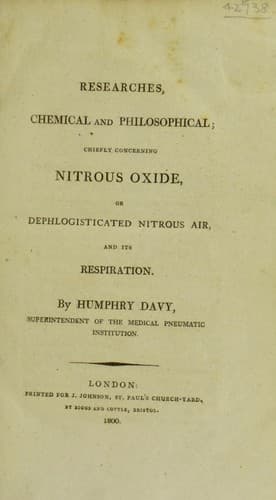
Researches Chemical and Philosophical; Chiefly concerning nitrous oxide: or dephlogisticated nitrous air and its respirationDavy, Humphry, Sir
Science
Researches Chemical and Philosophical; Chiefly concerning nitrous oxide: or dephlogisticated nitrous air and its respiration
Davy, Humphry, Sir
Nitrous oxide
The whole solution evaporated, gave 18 grains of compact nitrate of
ammoniac. But reasoning from the quantity of carbonate of ammoniac
employed, the free nitric acid was equal to 2,75 grains, and this must
have formed 3,56 grains of salt. Consequently the salt pre-existing in
the solution was about 14,44 grains.
But besides the fluid taken out of the recipient, 2 grains remained in
it: let us suppose this, and the 4 grains lost, to contain 2 of salt,
and,6 of free acid.
Then the undecompounded
salt is 5,5 + 14,4 + 2 = 21,9
The free acid 2,75 + ,6 = 3,35
Gas 42,5
Water 32,25
——————
100
Now about 78,1 grains of salt were decompounded, and formed into 42,5
grains of gas, 3,35 grains acid, and 32,25 grains water.
But there is every reason to suppose, that in this process, when the
hydrogene of the ammoniac combines with a portion of the oxygene of
the nitric acid to form water, and the nitrogene enters into union
with the nitrogene and remaining oxygene of the nitric acid, to form
nitrous oxide; that water pre-existing in nitric acid and ammoniac,
such as they existed in the aëriform state, is deposited with the water
produced by the new arrangement, and not wholly combined with the
nitrous oxide formed. Hence it is impossible to determine with great
exactness, the quantity of water which was absolutely formed in this
experiment.
78,1 grains of salt are composed of 15,4 alkali, 58 acid, and 4,7 water.
And reasoning from the different affinities of water for nitric acid,
ammoniac, and nitrous oxide, it is probable that ammoniac, in its
decomposition, divides its water in such a ratio, between the nitrogene
furnished to the nitrous oxide, and the hydrogene entering into union
with the oxygene of the nitric acid, as to enable us to assume, that
the hydrogene requires for its saturation nearly the same quantity of
oxygene as when in the aëriform state; or that it certainly cannot
require less.
But 15,4 alkali contain 3,08 hydrogene, and 12,32 nitrogene;[87] and
3,08 hydrogene require 17,4 of oxygene to form 20,48 of water.
[87] Owing part of their weight to an unknown quantity of water.
Now 32,5 grains of water existed before the experiment; 4,7 grains of
water were contained by the salt decomposed, and 32,5-4,7 = 27,8: and
27,8-20,48, the quantity generated, = 7,52, the quantity existing in
the nitric acid.
Public-domain text, read in full here on John Shaqi.
Reviews
Reviews
No reviews yet
Be the first to share your thoughts on this work.
Join the Discussion
Join the discussion
Sign in to leave a comment or review.
Sign InorCreate an account