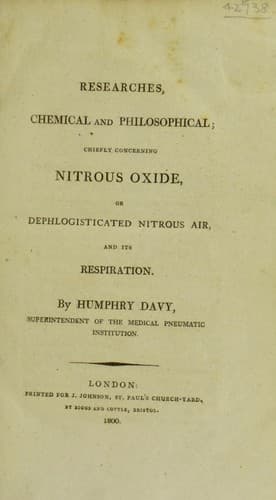
Researches Chemical and Philosophical; Chiefly concerning nitrous oxide: or dephlogisticated nitrous air and its respirationDavy, Humphry, Sir
Science
Researches Chemical and Philosophical; Chiefly concerning nitrous oxide: or dephlogisticated nitrous air and its respiration
Davy, Humphry, Sir
Nitrous oxide
But the nitric acid decomposed is 58ᵍ-3,35 = to 54,7; and 54,7-7,5
= 47,2, which entered into new combinations. These 47,2 consist of
33,2 oxygene, and 14, nitrogene. And 33,2-17,4, the quantity employed
to form the water, = 15,8, which combined with 14,0, nitrogene of
the nitric acid, and 12,32 of that of the ammoniac, to form 42,12 of
nitrous oxide. And on this estimation, 100 parts of nitrous oxide
would contain 37,6 oxygene, and 62,4 nitrogene; a computation much
nearer the results of the analysis than could have been expected,
particularly as so many unavoidable sources of error existed in the
process.
The experiment that I have detailed is the most accurate of four, made
on the same quantity of salt. The others were carried on at rather
higher temperatures, in consequence of which, more water and salt were
sublimed with the gas.
To Berthollet, we owe the discovery of the products evolved during the
slow decomposition of nitrate of ammoniac; but as this philosopher
in his examination of this process, chiefly designed to prove the
existence of hydrogene in ammoniac, he did not ascertain the quantity
of gas produced, or minutely examine its properties; from two of
them, its absorption by water and its capability of supporting the
vivid combustion of a taper, he inferred its identity with the
dephlogisticated nitrous gas of Priestley, and concluded that it was
nitrous gas with excess of pure air.[88]
[88] Mem. de Paris. 1785, and Journal de Physique, 1786, page 175.
VII. _Of the heat produced during the decomposition of nitrate of
ammoniac._
To ascertain whether the temperature of nitrate of ammoniac was
increased or diminished after it had been raised to the point essential
to its decomposition, during the evolution of nitrous oxide and water;
that is, in common language, whether heat was generated or absorbed
in the process; I introduced a thermometer into about 1500 grains of
fibrous nitrate of ammoniac, rendered liquid in a deep porcelain cup.
During the whole of the evaporation, the temperature was about 380°,
the fire being carefully regulated.
As soon as the decomposition took place, the thermometer began to rise;
in less than a quarter of a minute it was 410°, in two minutes it was
460°.
The cup was removed from the fire; the decomposition still went on
rapidly, and for about a minute the thermometer was stationary. It
then gradually and slowly fell; in three minutes it was 440°, in
five minutes 420°, in seven minutes 405° in nine minutes 360° and in
thirteen minutes 307°, when the decomposition had nearly ceased, and
the salt began to solidify.
From this experiment, it is evident that an increase of temperature
is produced by the decomposition of nitrate of ammoniac: though the
capacity of water and nitrous oxide for heat, supposing the truth of
the common doctrine, and reasoning from analogy, must be considerably
greater than that of the salt.
Public-domain text, read in full here on John Shaqi.
Reviews
Reviews
No reviews yet
Be the first to share your thoughts on this work.
Join the Discussion
Join the discussion
Sign in to leave a comment or review.
Sign InorCreate an account