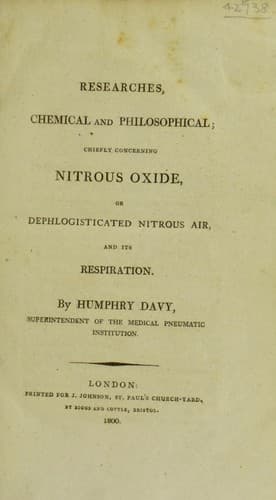
Researches Chemical and Philosophical; Chiefly concerning nitrous oxide: or dephlogisticated nitrous air and its respirationDavy, Humphry, Sir
Science
Researches Chemical and Philosophical; Chiefly concerning nitrous oxide: or dephlogisticated nitrous air and its respiration
Davy, Humphry, Sir
Nitrous oxide
VIII. _Of the decomposition of Nitrate of Ammoniac at high
temperatures, and production of Nitrous gas, Nitrogene, Nitrous Acid,
and Water._
At an early period of my investigation relating to the nitrous oxide,
I discovered that when a heat above 600° was applied to nitrate of
ammoniac, so that a vivid luminous appearance was produced in the
retort, certain portions of nitrous gas, and nitrogene, were evolved
with the nitrous oxide. But I was for some time ignorant of the
precise nature of this decomposition, and doubtful with regard to
the possibility of effecting it in such a manner as to prevent the
production of nitrous oxide altogether.
I first attempted to decompose nitrate of ammoniac at high
temperatures, by introducing it into a well coated green glass retort,
having a wide neck, communicating with the pneumatic apparatus, and
strongly heated in an air-furnace. But though in this process a
detonation always took place, and much light was produced, yet still
the greater portion of the gas generated was nitrous oxide; the nitrous
gas and nitrogene never amounting to more than one third of the whole.
After breaking many retorts by explosions, without gaining any accurate
results, I employed a porcelain tube, curved so as to be capable of
introduction into the pneumatic apparatus, and closed at one end.
The closed end was heated red, nitrate of ammoniac introduced into it,
and all the latter portions of gas produced in the explosion, received
in the pneumatic apparatus, filled with warm water.
Three explosions were required to fill a jar of the capacity of 20
cubic inches. The gas produced in the first, when it came over, was
transparent and dark orange, similar in its appearance to the nitrous
acid gas produced in the first experiment; but it speedily became white
and clouded, whilst a slight diminution of volume took place.
When the second portion was generated and mingled with the clouded
gas, it again became transparent and yellow for a short time, and then
assumed the same appearance as before.
The water in the trough, after this experiment, had an acid taste, and
quickly reddened cabbage juice rendered green by an alkali.
6 cubic inches of the gas produced were exposed to boiled water, but
little or no absorption took place. Hence, evidently, it contained no
nitrous oxide.
They were then exposed to solution of sulphate of iron: the solution
quickly became dark colored, and an absorption of 1,6 took place on
agitation.[89]
[89] The absorption of nitrous gas by sulphate of iron, &c. will be
treated of in the next division.
The gas remaining instantly extinguished the taper, and was
consequently nitrogene.
This experiment was repeated, with nearly the same results.
We may then conclude, that at high temperatures, nitrate of ammoniac is
wholly resolved into water, nitrous acid, nitrous gas, and nitrogene;
whilst a vivid luminous appearance is produced.
Public-domain text, read in full here on John Shaqi.
Reviews
Reviews
No reviews yet
Be the first to share your thoughts on this work.
Join the Discussion
Join the discussion
Sign in to leave a comment or review.
Sign InorCreate an account