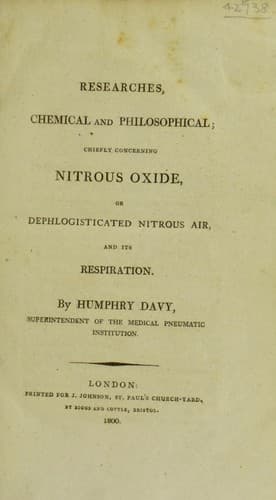
Researches Chemical and Philosophical; Chiefly concerning nitrous oxide: or dephlogisticated nitrous air and its respirationDavy, Humphry, Sir
Science
Researches Chemical and Philosophical; Chiefly concerning nitrous oxide: or dephlogisticated nitrous air and its respiration
Davy, Humphry, Sir
Nitrous oxide
The transparency and orange color produced in the gas that had been
clouded, by new portions of it, doubtless arose from the solution of
the nitric acid and water forming the cloud, in the heated nitrous
vapor produced, so as to constitute an aëriform triple compound;
whilst the cloudiness and absorption subsequent were produced by the
diminished temperature, which destroyed the ternary combination, and
separated the nitrous acid and water from the nitrous gas.
From the rapidity with which the deflagration of nitrate of ammoniac
proceeds, and from the immense quantity of light produced, it is
reasonable to suppose that a very great increase of temperature takes
place. The tube in which the decomposition has been effected, is always
ignited after the process.
IX. _Speculations on the decompositions of Nitrate of Ammoniac._
All the phænomena of chemistry concur in proving, that the affinity of
one body, A, for another, B, is not destroyed by its combination with a
third, C, but only modified; either by condensation, or expansion, or
by the attraction of C for B.
On this principle, the attraction of compound bodies for each other
must be resolved into the reciprocal attractions of their constituents,
and consequently the changes produced in them by variations of
temperature explained, from the alterations produced in the attractions
of those constituents.
Thus in nitrate of ammoniac, four affinities may be supposed to exist:
1. That of hydrogene for nitrogene, producing ammoniac.
2. That of oxygene for nitrous gas, producing nitric acid.
3. That of the hydrogene of ammoniac for the oxygene
of nitric acid.
4. That of the nitrogene of ammoniac for the nitrous gas
of nitric acid.
At temperatures below 300°, the salt, from the equilibrium between
these affinities, preserves its existence.
Now when its temperature is raised to 400°, the attractions of
hydrogene for nitrogene,[90] and of nitrous gas for oxygene,[91] are
diminished; whilst the attraction of hydrogene for oxygene[92] is
increased; and perhaps that of nitrogene for nitrous gas.
[90] As is evident from the decomposition of ammoniac by heat.
[91] Nitric acid is phlogisticated by heat, as appears from Dr.
Priestley’s experiments. Vol. 3, p. 26.
[92] As is evident from the increase of temperature required for the
formation of water.
Hence the former equilibrium of affinity is destroyed, and a new one
produced.
The hydrogene of the ammoniac combines with the oxygene of the nitric
acid to generate water; and the nitrogene of the ammoniac enters into
combination with the nitrous gas to form nitrous oxide: and the water
and nitrous oxide produced, most probably exist in binary combination
in the aëriform state, at the temperature of the decomposition.
Public-domain text, read in full here on John Shaqi.
Reviews
Reviews
No reviews yet
Be the first to share your thoughts on this work.
Join the Discussion
Join the discussion
Sign in to leave a comment or review.
Sign InorCreate an account