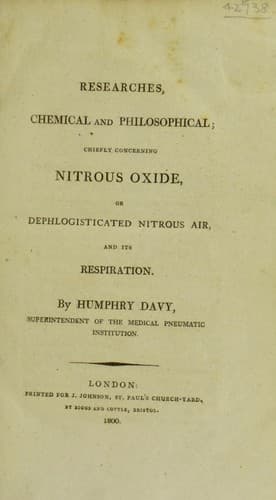
Researches Chemical and Philosophical; Chiefly concerning nitrous oxide: or dephlogisticated nitrous air and its respirationDavy, Humphry, Sir
Science
Researches Chemical and Philosophical; Chiefly concerning nitrous oxide: or dephlogisticated nitrous air and its respiration
Davy, Humphry, Sir
Nitrous oxide
But when a heat above 800° is applied to nitrate of ammoniac, the
attractions of nitrogene and hydrogene for each other, and of
oxygene for nitrous gas,[93] are still more diminished; whilst that
of nitrogene for nitrous gas is destroyed, and that of hydrogene
for oxygene increased to a great extent: likewise a new attraction
takes place; that of nitrous gas for nitric acid, to form nitrous
vapor.[94] Hence a new arrangement of principles is rapidly produced;
the nitrogene of ammoniac having no affinity for any of the single
principles at this temperature, enters into no binary compound: the
oxygene of the nitric acid forms water with the hydrogene, and the
nitrous gas combines with the nitric acid to form nitrous vapor. All
these substances most probably exist in combination at the temperature
of their production; and at a lower temperature, assume the forms of
nitrous acid, nitrous gas, nitrogene, and water.
[93] For ammoniac and nitrous oxide are both decomposed at the red
heat, and oxygene given out from nitric acid when it is passed through
a heated tube.
[94] Whenever nitrous acid is produced at high temperatures, it is
always highly phlogisticated, provided it has not been long in contact
with oxygene. When Dr. Priestley passed nitric acid through a tube
heated red, he procured much oxygene, and phlogisticated acid; and the
water in the apparatus employed was fully impregnated with nitrous air.
Hence it would appear, that heat diminishes the attraction between
oxygene and nitrous gas, and increases the affinity of nitrous gas for
nitrous acid. Mr. JAMES THOMSON, whose theory of the Nitrous Acid I
have already mentioned, from some experiments on the phlogistication
of Nitric Acid by heat, which he has communicated to me, concludes
with great justness, that a portion of the acid is always completely
decomposed in this process: the oxygene liberated, and the nitrous gas
combined with the remaining acid.
I have avoided entering into any discussions concerning the light
and heat produced in this process; because these phænomena cannot be
reasoned upon as isolated facts, and their relation to general theory
will be treated of hereafter.
X. _On the preparation of Nitrous Oxide for experiments on Respiration._
When compact nitrate of ammoniac is slowly decomposed, the nitrous
oxide produced is almost immediately fit for respiration; but as one
part of the salt begins to decompose before the other is rendered
fluid, a considerable loss is produced by sublimation.
For the production of large quantities of nitrous oxide, fibrous
nitrate of ammoniac should be employed. This salt undergoes no
decomposition till the greater part of its water is evaporated, and in
consequence at the commencement of that process, is uniformly heated.
Public-domain text, read in full here on John Shaqi.
Reviews
Reviews
No reviews yet
Be the first to share your thoughts on this work.
Join the Discussion
Join the discussion
Sign in to leave a comment or review.
Sign InorCreate an account