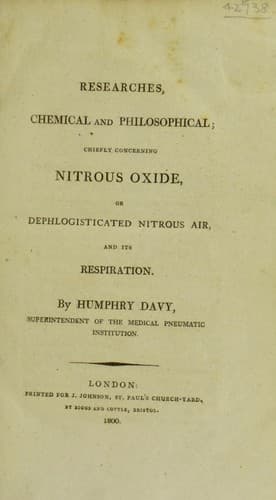
Researches Chemical and Philosophical; Chiefly concerning nitrous oxide: or dephlogisticated nitrous air and its respirationDavy, Humphry, Sir
Science
Researches Chemical and Philosophical; Chiefly concerning nitrous oxide: or dephlogisticated nitrous air and its respiration
Davy, Humphry, Sir
Nitrous oxide
The gas produced from fibrous nitrate, must be suffered to rest at
least for an hour after its generation. At the end of this time it is
generally fit for respiration. If examined before, it will be found
to contain more or less of a white vapor, which has a disagreeable
acidulous taste, and strongly irritates the fauces and lungs. This
vapor, most probably, consists of acid nitrate of ammoniac and water,
which were dissolved by the gas at the temperature of its production,
and afterwards slowly precipitated.
It is found in less quantity when compact nitrate is employed,
because more salt is sublimed in this process, which being rapidly
precipitated, carries with it the acid and water.
Whatever salt is employed, the last portions of gas produced, generally
contain less vapor, and may in consequence be respired sooner than the
first.
The nitrate of ammoniac should never be decomposed in a metallic
vessel,[95] nor the gas produced suffered to come in contact with
any metallic surface; for in this case the free nitric acid will be
decomposed, and in consequence, a certain quantity of nitrous gas
produced.
[95] Except it be gold or platina.
The apparatus that has been generally employed in the medical pneumatic
institution, for the production of nitrous oxide, consists
1. Of a glass retort, of the capacity of two or three quarts,
orificed at the top, and furnished with a ground stopper.
2. Of a glass tube, conical for the purpose of receiving the
neck of the retort; about ,4 inches wide in the narrowest
part, 4 feet long, curved at the extremity, so as to be
capable of introduction into an airholder, and inclosed by
tin plate to preserve it from injury.
3. Of airholders of Mr. Watt’s invention, filled with water
saturated with nitrous oxide.
4. Of a common air-furnace, provided with dampers for the
regulation of the heat.
The retort, after the insertion of the salt, is connected with the
tube, carefully luted, and exposed to the heat of the furnace, on a
convenient stand. The temperature is never suffered to be above 500°.
After the decomposition has proceeded for about a minute, so that the
gas evolved from the tube enlarges the flame of a taper, the curved end
is inserted into the airholder, and the nitrous oxide preserved.
The water thrown out of the airholders in consequence of the
introduction of the gas, is preserved in a vessel adapted for the
purpose, and employed to fill them again; for if common water was to
be employed in every experiment, a great loss of gas would be produced
from absorption.
A pound of fibrous nitrate of ammoniac, decomposed at a heat not above
500°, produces nearly 5 cubic feet of gas; whilst from a pound of
compact nitrate of ammoniac, rarely more than 4,25 cubic feet can be
collected.
Public-domain text, read in full here on John Shaqi.
Reviews
Reviews
No reviews yet
Be the first to share your thoughts on this work.
Elsewhere in the archive
Join the Discussion
Join the discussion
Sign in to leave a comment or review.
Sign InorCreate an account