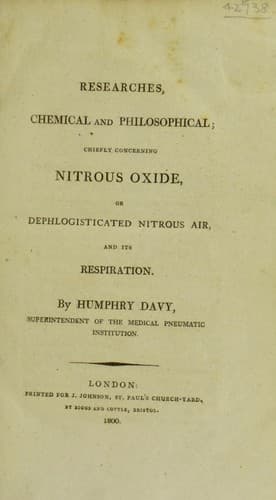
Researches Chemical and Philosophical; Chiefly concerning nitrous oxide: or dephlogisticated nitrous air and its respirationDavy, Humphry, Sir
Science
Researches Chemical and Philosophical; Chiefly concerning nitrous oxide: or dephlogisticated nitrous air and its respiration
Davy, Humphry, Sir
Nitrous oxide
For the production of nitrous oxide in quantities not exceeding 20
quarts, a mode still more simple than that I have just described may be
employed. The salt may be decomposed by the heat of an argands lamp, or
a common fire, in a tubulated glass retort, of 20 or 30 cubic inches in
capacity, furnished with a long neck, curved at the extremity; and the
gas received in small airholders.
Thus, if the pleasurable effects, or medical properties of the nitrous
oxide, should ever make it an article of general request, it may be
procured with much less time, labor, and expence,[96] than most of the
luxuries, or even necessaries, of life.
[96] A pound of nitrate of ammoniac costs about 5s. 10d. This pound,
properly decomposed, produces rather more than 34 moderate doses of
air; so that the expence of a dose is about 2d. What fluid stimulus can
be procured at so cheap a rate?
DIVISION IV.
_EXPERIMENTS and OBSERVATIONS on the COMPOSITION of
NITROUS GAS, and on its ABSORPTION by different
bodies._
I. _Preliminaries._
In my account of the composition of nitric acid, in Division I. I gave
an estimation of the quantities of oxygene and nitrogene combined
in nitrous gas: I shall now detail the experiments on which that
estimation is founded.
At an early period of my researches relating to nitrous oxide, from
the observation of the phænomena taking place during the production of
this substance, I had concluded, that the common opinion with regard
to the composition of nitrous gas, was very distant from the truth.
I had indeed analysed nitrous gas, by converting it into nitrous
oxide, before I attempted to ascertain its composition by immediately
separating the constituent principles from each other: and my first
hopes of the possibility of effecting this, were derived from Dr.
Priestley’s experiments on the combustion of pyrophorus in nitrous gas,
and on the changes effected in it, by heated iron and charcoal.
This great philosopher found, that pyrophorus placed in contact with
nitrous gas, burnt with great vividness, whilst the gas was diminished
in volume to about one half, which generally consisted of nitrogene
and nitrous oxide. He likewise found, iron heated by a lens in nitrous
gas, increased in weight, whilst the gas was diminished about ½, and
converted into nitrogene.[97]
He heated common charcoal, and charcoal of copper,[98] in nitrous gas
by a lens. When common charcoal was employed, the gas was neither
increased or diminished in bulk, but wholly converted into nitrogene;
when charcoal of copper was used, the volume was a little increased,
and the gas remaining consisted of ⁵/₇ nitrogene, and ²/₇ carbonic acid.
[97] Experiments and Observations, vol. II. pag. 50. Last Edition.
[98] That is, charcoal produced by the decomposition of spirits of
wine. Vol. II. pag. 39.
Public-domain text, read in full here on John Shaqi.
Reviews
Reviews
No reviews yet
Be the first to share your thoughts on this work.
Elsewhere in the archive
Join the Discussion
Join the discussion
Sign in to leave a comment or review.
Sign InorCreate an account