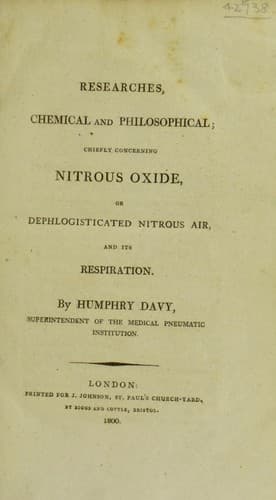
Researches Chemical and Philosophical; Chiefly concerning nitrous oxide: or dephlogisticated nitrous air and its respirationDavy, Humphry, Sir
Science
Researches Chemical and Philosophical; Chiefly concerning nitrous oxide: or dephlogisticated nitrous air and its respiration
Davy, Humphry, Sir
Nitrous oxide
In his experiments on the iron and pyrophyrus, the nitrous gas
was evidently decomposed. From the great quantity of nitrogene
produced in those on the charcoal, it seems likely that both the
common charcoal,[99] and the charcoal of copper employed contained
atmospherical air, which being dispelled by the heat of the lens,
was decomposed by the nitrous gas: indeed, till I made the following
experiment, I suspected that the carbonic acid produced, when the
charcoal of copper was employed, arose from a decomposition of the
nitrous acid, formed in this way.
[99] Dr. Priestley says, “having heated iron in nitrous air, I
proceeded to heat in the same air, a piece of charcoal not long after
it had been subjected to a strong heat covered with sand. The sun
not shining immediately, after the charcoal was introduced into the
vessel of air, through the mercury by which it was confined, part
of the air was absorbed; but on heating the charcoal, the quantity
was increased. Having continued the progress as long as I thought
necessary, I examined the air and found it to be about as much as
the original quantity of nitrous air; but it was all phlogisticated
air extinguishing a candle and having no mixture of fixed air in
it.”—Experiments and Observations, Vol. II, page 39.
I introduced a piece of well-burnt charcoal, which could hardly have
weighed the eighth of a grain, whilst red hot, under a cylinder filled
with mercury, and admitted to it half a cubic inch of nitrous gas. A
slight absorption took place.
The sun being very bright, I kept the charcoal in the focus of a
small lens for near a quarter of an hour. At the end of this time
the gas occupied a space nearly as before the experiment, and a very
minute portion of the charcoal had been consumed. On introducing
into the cylinder a small quantity of solution of strontian, a white
precipitation was perceived, and the gas slowly diminished to about
three tenths of a cubic inch. To these three tenths a little common air
was admitted, when very slight red fumes were perceived.
This experiment convinced me, that the attraction of charcoal for the
oxygene of nitrous gas, at high temperatures, was sufficiently strong
to effect a slow decomposition of it.
To be more accurately acquainted with this decomposition, and to learn
the quantities of carbonic acid and nitrogene produced from a known
quantity of nitrous gas, I proceeded in the following manner.
II. _Analysis of Nitrous Gas by Charcoal._
A quantity of nitrous gas was procured in a water apparatus, from
the decomposition of nitrous acid by mercury. A portion of it was
transferred to the mercurial trough. After the mercury and the jar
had been dried by bibulous paper, 40 measures of this portion were
agitated in a solution of sulphate of iron. The gas remaining after
the absorption was complete, filled about a measure and half; so that
the nitrous gas contained nearly ¹/₂₆ nitrogene.
Public-domain text, read in full here on John Shaqi.
Reviews
Reviews
No reviews yet
Be the first to share your thoughts on this work.
Elsewhere in the archive
Join the Discussion
Join the discussion
Sign in to leave a comment or review.
Sign InorCreate an account