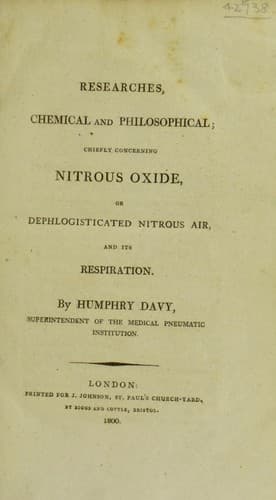
Researches Chemical and Philosophical; Chiefly concerning nitrous oxide: or dephlogisticated nitrous air and its respirationDavy, Humphry, Sir
Science
Researches Chemical and Philosophical; Chiefly concerning nitrous oxide: or dephlogisticated nitrous air and its respiration
Davy, Humphry, Sir
Nitrous oxide
Thermometer being 53°, a small piece of well-burnt charcoal, the
weight of which could hardly have equalled a quarter of a grain,
was introduced ignited, into a small cylinder filled with mercury,
graduated to,10 grain measures; to this, 16 measures, equal to 160
grain m. of nitrous gas, were admitted. An absorption of about one
measure and half took place. When the focus of a lens was thrown on the
charcoal, a slight increase of the gas was produced, from the emission
of that which had been absorbed.
After the process had been carried on for about a half an hour, the
charcoal evidently began to fume, and to consume very slowly, though no
alteration in the volume of the gas was observed.
The sun not constantly shining, the progress of the experiment was now
and then stopped: but taking the whole time, the focus could not have
been applied to it for less than four hours. When the process was
finished, the gas was increased in bulk nearly three quarters of a
measure.
A drop of water was introduced into the cylinder, by means of a small
glass tube, on the supposition that the carbonic acid, and nitrogene,
might be capable of holding in solution, more water than that contained
in the nitrous gas decomposed; but no alteration of volume took place.
When 20 grain measures of solution of pale green[100] sulphate of iron
were introduced into the cylinder, they became rather yellower than
before, but not dark at the edges, as is always the case when nitrous
gas is present. On agitation, a diminution of nearly half a measure was
produced, doubtless from the absorption of some of the carbonic acid by
the solution.
[100] That is, sulphate of iron containing oxide of iron, in the first
degree of oxygenation.
A small quantity of caustic potash, much more than was sufficient to
decompose the sulphate of iron, was now introduced. A rapid diminution
took place, and the gas remaining filled about 8 measures. This gas was
agitated for some time over water, but no absorption took place. Two
measures of it were then transferred into a detonating cylinder with
two measures of oxygene. The electric spark was puffed through them,
but no diminution was produced. Hence it was nitrogene, mingled with no
ascertainable quantity of hydrogene: consequently little or no water
could have been decomposed in the process.
Now supposing, for the greater ease of calculation, each of the
measures employed, cubic inches.
16 of nitrous gas—¹/₂₆ = 15,4 were decomposed, and these weigh, making
the necessary corrections, 5,2; but 7,4 nitrogene were produced, and
these weigh about 2,2. So that reasoning from the relative specific
gravities of nitrous gas and nitrogene, 5,2 grains of nitrous gas will
be composed of 3 oxygene, and 2,2 nitrogene.
Public-domain text, read in full here on John Shaqi.
Reviews
Reviews
No reviews yet
Be the first to share your thoughts on this work.
Elsewhere in the archive
Join the Discussion
Join the discussion
Sign in to leave a comment or review.
Sign InorCreate an account