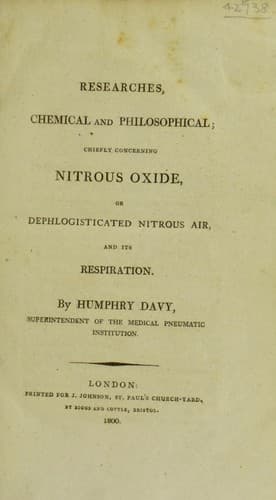
Researches Chemical and Philosophical; Chiefly concerning nitrous oxide: or dephlogisticated nitrous air and its respirationDavy, Humphry, Sir
Science
Researches Chemical and Philosophical; Chiefly concerning nitrous oxide: or dephlogisticated nitrous air and its respiration
Davy, Humphry, Sir
Nitrous oxide
But 8,7 of carbonic acid were produced, which weigh 4,1 grains, and
consist of 2,9 oxygene, and 1,2 charcoal.[101] Consequently, drawing
conclusions from the quantity of carbonic acid formed, 5,2 grains of
nitrous gas will consist of 2,9 oxygene, and 2,3 nitrogene.
[101] That is, carbon, or oxide of diamond.
The difference in these estimations is much less than could have been
expected; and taking the mean proportions, it would be inferred from
them, that 100 grains of nitrous gas, contain 56,5 oxygene, and 43,5
nitrogene.
I repeated this experiment with results not very different, except that
the increase of volume was rather greater, and that more unabsorbable
gas remained; which probably depended on the decomposition of a minute
quantity of water, that had adhered to the charcoal in passing through
the mercury.
As nitrous gas is decomposable into nitrous acid, and nitrogene, by the
electric spark; it occurred to me, that a certain quantity of nitrous
acid might have been possibly produced, in the experiments on the
decomposition of nitrous gas, by the intensely ignited charcoal. To
ascertain this circumstance, I introduced into 12 measures of nitrous
gas, a small piece of charcoal which had been just reddened. The sun
being very bright, the focus of the lens was kept on it for rather more
than an hour and quarter. In the middle of the process it began to fume
and to sparkle, as if in combustion. In three quarters of an hour, the
gas was increased rather more than half a measure; but no alteration of
volume took place afterwards.
The mercury was not white on the top as is usually the case when
nitrous acid is produced. On introducing into the cylinder a little
pale green sulphate of iron, and then adding prussiate of potash, a
white precipitate only was produced. Now, if the minutest quantity
of nitric acid had been formed, it would have been decomposed by the
pale green oxide of iron, and hence, a visible quantity of prussian
blue[102] produced, as will be fully explained hereafter.
[102] That is, blue prussiate of iron.
III. _Analysis of Nitrous Gas by Pyrophorus._
I placed some newly made pyrophorus, about as much as would fill
a quarter of a cubic inch, in a jar filled with dry mercury, and
introduced to it, four cubic inches of nitrous gas, procured from
mercury and nitric acid.
It instantly took fire and burnt with great vividness for some moments.
After the combustion had ceased, the gas was diminished about three
quarters of a cubic inch. The remainder was not examined; for the
diminution appeared to go on for some time, after; in an half hour,
when it was compleat, it was to 2 cubic inches. A taper, introduced
into these, burnt with an enlarged flame, blue at the edges; from
whence it appeared, that they were composed of nitrogene and nitrous
oxide.
Public-domain text, read in full here on John Shaqi.
Reviews
Reviews
No reviews yet
Be the first to share your thoughts on this work.
Elsewhere in the archive
Join the Discussion
Join the discussion
Sign in to leave a comment or review.
Sign InorCreate an account