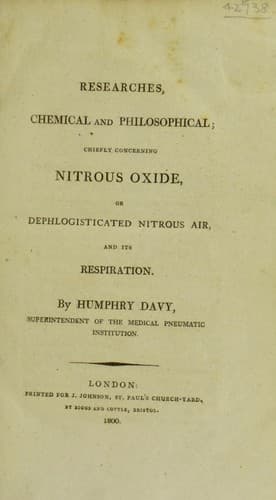
Researches Chemical and Philosophical; Chiefly concerning nitrous oxide: or dephlogisticated nitrous air and its respirationDavy, Humphry, Sir
Science
Researches Chemical and Philosophical; Chiefly concerning nitrous oxide: or dephlogisticated nitrous air and its respiration
Davy, Humphry, Sir
Nitrous oxide
I now introduced about half a cubic inch of pyrophorus to two cubic
inches of nitrous gas; the combustion took place, and the gas was
rapidly diminished to one half; and on suffering it to remain five
minutes to one third nearly; which extinguished flame.
Suspecting that this great diminution was owing to the absorption of
some of the nitrogene formed, by the charcoal of the pyrophorus, I
carefully made a quantity of pyrophorus; employing more than two thirds
of alumn, to one third of sugar.
To rather more than half of a cubic inch of this, two cubic inches of
nitrous gas, which contained about ¹/₄₀ nitrogene, were admitted. After
the combustion, the gas remaining, _apparently_ filled a space equal
to 1,2 cubic inches; but, as on account of the burnt pyrophyrus in the
jar, it was impossible to ascertain the volume with nicety, it was
carefully and wholly transferred into another jar. It filled a space
equal to 1,15 cubic inches nearly.
When water was admitted to this gas no absorption took place. It
underwent no diminution with nitrous gas, and a taper plunged into it
was instantly extinguished. We may consequently conclude that it was
nitrogene.
Now 2 cubic inches of nitrous gas weigh,686 grains, and 1,1 of
nitrogene—,05, the quantity previously contained in the gas = to 1,05,
3,19. Hence,686 of nitrous gas would be composed of,367 oxygene, and
,319 nitrogene; and 100 grains would contain 53,4 oxygene, and 46,6
nitrogene.
IV. _Additional observations on the combustion of bodies in Nitrous
Gas, and on its Composition._
Though phosphorus may be fused, and even sublimed, in nitrous gas,
without producing the slightest luminous appearance,[103] yet when it
is introduced into it in a state of active inflammation, it burns
with almost as much vividness as in oxygene.[104] Hence it is evident,
that at the heat of ignition, phosphorus is capable of attracting the
oxygene from the nitrogene of nitrous gas.
[103] No luminous appearance is produced when phosphorus is introduced
into _pure_ nitrous gas. It has been often observed, that phosphorus is
luminous in nitrous gas, that has not been long in contact with water
after its production. This phænomenon, I suspect, depends either on the
decomposition of the nitric acid held in solution by the nitrous gas;
or on the combination of the phosphorus with oxygene loosely adhering
to the binary aëriform compound of nitric acid and nitrous gas. I have
not yet examined if nitrous gas can be converted into nitrous oxide by
long exposure to heated phosphorus: it appears, however, very probable.
[104] Perhaps this fact has been noticed before; I have not, however,
met with it in any chemical work.
Public-domain text, read in full here on John Shaqi.
Reviews
Reviews
No reviews yet
Be the first to share your thoughts on this work.
Elsewhere in the archive
Join the Discussion
Join the discussion
Sign in to leave a comment or review.
Sign InorCreate an account