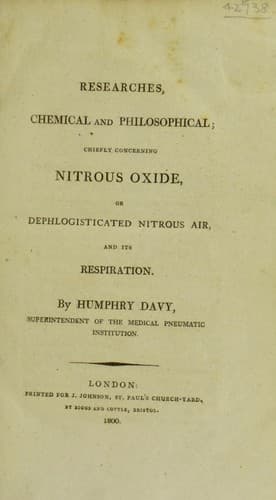
Researches Chemical and Philosophical; Chiefly concerning nitrous oxide: or dephlogisticated nitrous air and its respirationDavy, Humphry, Sir
Science
Researches Chemical and Philosophical; Chiefly concerning nitrous oxide: or dephlogisticated nitrous air and its respiration
Davy, Humphry, Sir
Nitrous oxide
Some very uncommon circumstances are attendant on the solution of
platina:
1st. The immense quantity of acid required for the solution of a minute
quantity of platina.
2d. The great quantity of gas produced during the solution of this
minute quantity.
3d. The intense red color of the solution, and its perfectly acid
properties after it ceases to act upon the metal.
XI. _On the action of the Electric Spark on a mixture of Nitrogene and
Nitrous Gas._
Thinking it possible that nitrous gas and nitrogene might be made to
combine by the action of the electric spark, so as to form nitrous
oxide, I introduced 20 grain measures of each of them into a small
detonating tube, graduated to grains, standing over mercury, and
containing a very small quantity of cabbage juice rendered green by an
alkali. After electric sparks had been passed through the gases for an
hour and half, they were diminished to about 32, and the cabbage juice
was slightly reddened. On introducing about 10 measures of hydrogene,
and passing the electric spark through the whole, no inflammation or
diminution was perceptible. Hence the condensation most probably arose
wholly from the formation of nitrous acid,[152] by the more intimate
union of the oxygene of nitrous gas with some of its nitrogene, as in
the experiments of Priestley.
[152] For if nitrous oxide had been formed, it would have been
decomposed by the hydrogene.
As the nascent nitrogene, in the decomposition of nitrate of ammoniac,
combines with a portion of oxygene and nitrogene, to form nitrous
oxide; it is probable that nitrous oxide may be produced during the
passage of nitrous gas and ammoniac through a heated tube.
XII. _General Remarks._
There are no reasons for supposing that nitrous oxide is formed in any
of the processes of nature; and the nice equilibrium of affinity by
which it is constituted, forbids us to hope for the power of composing
it from its simple principles. We must be content to produce it, either
directly or indirectly, from the decomposition of nitric acid. And as
in the decomposition of nitrate of ammoniac, not only all the nitrogene
of the nitric acid enters into the composition of the nitrous oxide
produced, but likewise that of the ammoniac, this process is by far
the cheapest, as well as the most expeditious. A mode of producing
ammoniac at little expence, has been proposed by Mr. Watt. Condensed
in the sulphuric acid, it can be easily made to combine with nitric
acid, from the decomposition of nitre by double affinity. And thus,
if the hopes which the experiments at the end of those researches
induce us to indulge, do not prove fallacious, a substance which has
been heretofore almost exclusively appropriated to the destruction of
mankind, may become, in the hands of philosophy, a means of producing
health and pleasurable sensation.
RESEARCH II.
INTO THE COMBINATIONS OF NITROUS OXIDE, AND ITS DECOMPOSITION BY
COMBUSTIBLE BODIES.
DIVISION I.
Public-domain text, read in full here on John Shaqi.
Reviews
Reviews
No reviews yet
Be the first to share your thoughts on this work.
Elsewhere in the archive
Join the Discussion
Join the discussion
Sign in to leave a comment or review.
Sign InorCreate an account