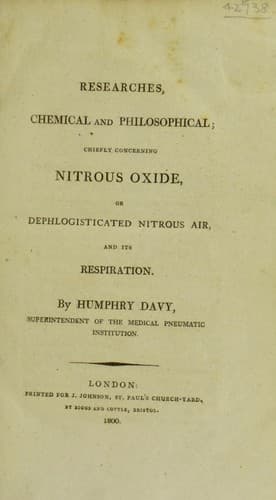
Researches Chemical and Philosophical; Chiefly concerning nitrous oxide: or dephlogisticated nitrous air and its respirationDavy, Humphry, Sir
Science
Researches Chemical and Philosophical; Chiefly concerning nitrous oxide: or dephlogisticated nitrous air and its respiration
Davy, Humphry, Sir
Nitrous oxide
_h._ To determine if any nitrogene had entered into chemical
combination with muriatic acid and oxygene, so as to form an aëriform
triple compound, analogous in its properties to oxygenated muriatic
acid, I exposed some of the gas to mercury, expecting that this
substance, by combining with its oxygene, would effect a complete
decomposition; and this was actually the case: for the gas was at
first rapidly diminished, and the mercury became oxydated; its volume,
however, soon increased; and the residual gas appeared to be nitrous,
mingled with much nitrogene. The exact proportions of each, from an
accident, I could not determine.
This experiment was inconclusive, because the nitro-muriatic acid
suspended in the peculiar gas, from which it can probably be never
perfectly freed, acted in common with it upon the mercury, and produced
nitrous gas: and this nitrous gas, at the moment of its production,
formed nitrous acid by combining with the oxygene of the peculiar
gas; and the nitrous acid generated[149] was again decomposed by the
mercury; and hence nitrous gas evolved, and possibly some nitrogene.
[149] The decomposition of aëriform nitrous acid by mercury, was first
noted by Priestley; vol. iii. pag. 101. This decomposition I have often
had occasion to observe. In reading Humbolt’s paper on eudiometry,
Annales de Chimie, xxviii, pag. 150, I was not a little surprised to
find that he takes no notice of this fact. He seems to suppose that
nitrous acid can remain aëriform, and even be condensed, in contact
with mercury, without alteration. He says, “In mingling 100 parts of
atmospheric air with 100 of nitrous air, the air immediately became
red, but all the acid produced remained aëriform; and after eighteen
hours some _drops_ only of acid were formed, which _swam_ upon the
mercury.”
_i._ Peculiar circumstances prevented me at this time from completely
investigating the subject. It remains doubtful whether the gas consists
simply of highly oxygenated muriatic acid and nitrogene,[150] produced
by the decomposition of nitric acid from the coalescing affinities of
platina and muriatic acid for oxygene; or whether it is composed of a
_peculiar_ gas, analogous to oxygenated muriatic acid, and nitrogene,
generated from some unknown affinities.[151]
[150] Lavoisier has said concerning aqua regia, “In solutions of metals
in this acid, as in all other acids, the metals are first oxydated,
by attracting a part of the oxygene from the compound radical. This
occasions the disengagement of a particular species of gas not hitherto
described, which may be called nitro-muriatic gas. It has a very
disagreeable smell, and is fatal to animal life when respired; it
attacks iron, and causes it to rust; it is absorbed in considerable
quantities by water.” Elem. Eng. 237.
[151] I have no doubt but that the gas procured from the solution of
gold in aqua regia, is analogous to that produced from platina.
Public-domain text, read in full here on John Shaqi.
Reviews
Reviews
No reviews yet
Be the first to share your thoughts on this work.
Elsewhere in the archive
Join the Discussion
Join the discussion
Sign in to leave a comment or review.
Sign InorCreate an account