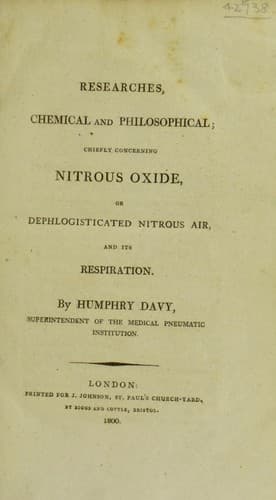
Researches Chemical and Philosophical; Chiefly concerning nitrous oxide: or dephlogisticated nitrous air and its respirationDavy, Humphry, Sir
Science
Researches Chemical and Philosophical; Chiefly concerning nitrous oxide: or dephlogisticated nitrous air and its respiration
Davy, Humphry, Sir
Nitrous oxide
_f._ I have before mentioned, Division III, that nitrous oxide, during
its combination with spring water, expels the common air dissolved in
it. This common air generally amounts to one sixteenth, the volume of
the water being unity. A correction on account of this circumstance
must be made for the apparent deficiency of diminution, and for the
common air mingled in consequence, with nitrous oxide during its
absorption by common water.
_g._ Water impregnated with nitrous gas absorbed nitrous oxide; but the
residual gas was much greater than that of common water, and gave red
fumes with atmospheric air. Nitrous gas agitated for a long while over
water highly impregnated with nitrous oxide, was not in the slightest
degree diminished, in one experiment indeed it was rather increased;
doubtless from the liberation of some nitrous oxide from the water by
the agitation.
_h._ Nitrous oxide kept in contact with aqueous solution of sulphurated
hydrogene and often agitated, was not in the slightest degree
diminished.
Sulphurated hydrogene, introduced into a solution of nitrous oxide, was
rapidly absorbed, and as the process advanced, the nitrous oxide was
given out.
_i._ Water impregnated with carbonic acid, possessed no action upon
nitrous oxide, and did not in the slightest degree absorb it. When
carbonic acid was introduced to an aqueous solution of nitrous oxide;
the aëriform acid was absorbed, and the nitrous oxide liberated.
_k._ From these observations it appears that nitrous oxide has less
affinity for water, than even the weaker acids, sulphurated hydrogene
and carbonic acid; as indeed one might have conjectured a priori from
its degree of solubility: likewise that it has a stronger attraction
for water than the gases not possessed of acid or alkaline properties;
it expelling from water nitrous gas, oxygene, and common air; probably
hydrocarbonate, hydrogene, and nitrogene.
II. _Combinations of Nitrous Oxide with Fluid Inflammable Bodies._
_a._ Vitriolic ether absorbs nitrous oxide in much larger quantities
than water.
A cubic inch of ether, at temperature 52°, combined with a cubic inch
and seven tenths of nitrous oxide.
Ether thus impregnated was not at all altered in its appearance; its
smell was precisely the same, but the taste appeared less pungent, and
more agreeable. Nitrous oxide is liberated unaltered from ether at a
very low temperature, that is, at about the boiling point of this fluid.
For expelling nitrous oxide from impregnated ether, and for
ascertaining in general the quantity of gases combined with fluids, I
have lately made use of a very simple method, which it may not be amiss
to describe.
The impregnated fluid is introduced into a small thin tube, graduated
to,05 cubic inches, through mercury. The quantity of fluid should never
equal more than a fifth or sixth of the capacity of the tube.
Public-domain text, read in full here on John Shaqi.
Reviews
Reviews
No reviews yet
Be the first to share your thoughts on this work.
Elsewhere in the archive
Join the Discussion
Join the discussion
Sign in to leave a comment or review.
Sign InorCreate an account