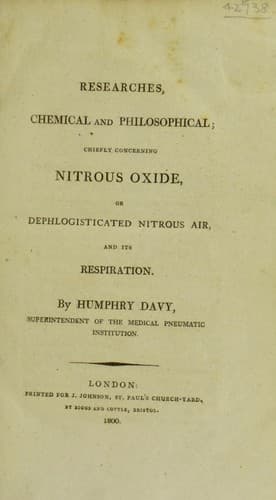
Researches Chemical and Philosophical; Chiefly concerning nitrous oxide: or dephlogisticated nitrous air and its respirationDavy, Humphry, Sir
Science
Researches Chemical and Philosophical; Chiefly concerning nitrous oxide: or dephlogisticated nitrous air and its respiration
Davy, Humphry, Sir
Nitrous oxide
The lower part of the tube is adapted to an orifice in the shelf of
the mercurial apparatus, so as to make an angle of about 40° with the
surface of the mercury.
The flame of a small spirit lamp is then applied to that part of the
tube containing the fluid; and after the expulsion of the gas from it,
the heat is raised so as to drive out the fluid through the orifice of
the tube. Thus the liberated gas is preserved in a state proper for
accurate examination.
Impregnated ether, during its combination with water, gives out the
greater part of its nitrous oxide. During the liberation of nitrous
oxide from ether, by its combination with water, a very curious
phænomenon takes place.
If the water employed is colored, so that it may be seen in a stratum
distinct from the impregnated ether, at the point of contact a number
of small spherules of fluid will be perceived, apparently repulsive
both to water and ether; these spherules become gradually covered
with minute globules of gas, and as this gas is liberated from their
surfaces, they gradually disappear.
_b._ Alcohol dissolves considerable quantities of nitrous oxide.
2 cubic inches of alcohol, at 52°, combined with 2,4 cubic inches of
nitrous oxide. The alcohol thus impregnated had a taste rather sweeter
than before, but in other physical properties was not perceptibly
altered.
Nitrous oxide is incapable of remaining in combination with this fluid
at the temperature of ebullition; it is liberated from it unaltered by
heat.
Impregnated alcohol, during its combination with water, gives out
the greater part of its combined nitrous oxide: on mingling the two
fluids together, at the point of contact the alcohol becomes covered
with an infinite number of small globules of gas, which continue to be
generated during the whole of the combination, and in passing through
the fluid render it almost opaque.
_c._ The essential oils absorb nitrous oxide to a greater extent than
either alcohol or ether.
,5 cubic inches of oil of carui combined with 1,2 cubic inches of
nitrous oxide at 51°. The color of the oil thus impregnated was rather
paler than before.
Nitrous oxide is expelled unaltered from impregnated oil of carui, by
heat.
1 of oil of turpentine absorbed nearly 2 of nitrous oxide, at 57°. Its
properties were not sensibly altered from this combination, and the gas
was expelled from it undecompounded, by heat.
_d._ As well as the essential oils, the fixed oils dissolve nitrous
oxide at low temperatures, whilst at high temperatures they do not
remain in combination.
1 of olive oil absorbed, at 61°, 1,2 of nitrous oxide, but without
undergoing any apparent physical change.
III. _Action of Fluid Acids on Nitrous Oxide._
_a._ Nitrous oxide exposed to concentrated sulphuric acid, undergoes no
change, and suffers no diminution, that may not be accounted for from
the abstraction of a portion of its water by the acid.
Public-domain text, read in full here on John Shaqi.
Reviews
Reviews
No reviews yet
Be the first to share your thoughts on this work.
Elsewhere in the archive
Join the Discussion
Join the discussion
Sign in to leave a comment or review.
Sign InorCreate an account