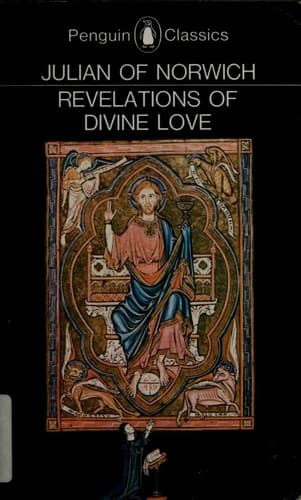
Sometimes there is for the mystics a partaking of these lesser
"wayside sacraments," sometimes a turning aside from their symbols;
sometimes the old song of life in the lower creation awakens singing,
sometimes it scarcely is heard. But always the _spirit_ of nature's
signs as interpreted in Man, above all in Christ, lays its claim on
the soul; always as sung by the chorus of human spirits that live on
the "Righteousness, Peace, and Joy" of the Will of God, the New Song
of Life through Death has in it a summons and receives from one and
another here, passing through much tribulation, its fuller concord of
human achievement, or at least the desirous _Amen_. So whether the
mystic dwell much or little with the sights and sounds of sense, those
things that are seen and heard by the _soul_ bear to him the command
of his home, and the merest doorway glimpses, the echoes most distant,
making their proffer of more and more within and beyond, say _Come_.
"I give you the end of a golden string:
Only wind it into a ball,
It will lead you in at Heaven's Gate,
Built in Jerusalem wall."[4]
(Although this "following on to know," this winding of the truth
caught hold of into a "perfect round" of thought and will and life, is
probably not more easy for the mystics than for other people.
"Amore, amor, tu sei cerchio rotondo!"[5])
God is in all; but "our soul may never have rest in things that are
beneath itself" (lxvii.). "Well I wot," says Julian, "that heaven and
earth and all that is made is great and large, fair and good," yet "all
that is made" is seen as a little thing, the size of a hazel nut, held
in the palm of her hand, when along with it her spiritual sight beholds
the Maker. And though we may find the Maker in all things, we find
Him, both as Maker and Restorer, first and best, First and Last, in
the soul. There He is _Alpha_, there _Omega_. "It is readier to us to
come to the knowing of God than to know our own Soul" (in its fullest
powers). "For our soul is so deep-grounded in God and so endlessly
treasured, that we may not come to the knowing thereof till we have
first knowing of God, which is the Maker, to whom it is oned." And yet,
"we may never come to full knowing of God till we know first clearly
our own soul" (lvi.). The knowledge begins with God, but it begins
with Him in the lowest place of the soul rescued from sin by mercy and
entered by grace. "For Himself is nearest and meekest, highest and
lowest, and doeth all" (lxxx.). To the soul that looks on Christ a
remembrance rises of its own "fair nature" made in His image; yet "our
Lord of His mercy sheweth us our sin and our feebleness by the sweet
gracious light of Himself" (lxxviii.). Thus in the working of grace
the soul comes to the knowledge both of its higher and lower parts.
For in finding in itself both a natural response to the working of
grace by its love and its longing after God, and a contrariness to the
Public-domain text, read in full here on John Shaqi.
Reviews
Reviews
No reviews yet
Be the first to share your thoughts on this work.
Join the Discussion
Join the discussion
Sign in to leave a comment or review.
Sign InorCreate an account