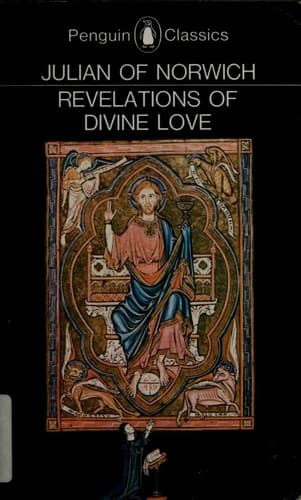
In _Carrow Abbey_, by Walter Rye (privately printed, 1889), is given a
list of Wills, in which the name of the Lady Julian Lampet frequently
occurs as a legatee between the years 1427 (Will of Sir John Erpingham)
and 1478 (Will of William Hallys). Comparing the Will of Hallys with
that of Margaret Purdance, which was made in 1471 but not proved till
1483, and from which the name of Lady Julian Lampet as a legatee is
stroked out, no doubt because of her death, we find evidence that this
anchoress died between 1478 and 1483. As even the earlier of these
dates was a hundred and thirty-six years after the birth of the writer
of the "Revelations," who in May 1373 was over thirty years of age,
the identity of the "Lady Julian, recluse at Norwich," with the Lady
Julian Lampet, though it has naturally been suggested, is surely an
impossibility. There were anchorages in the churchyards both of St
Julian's, Conisford (which belonged to the nuns of Carrow in the sense
of its revenues having been made over to them by King Stephen for the
support of that Priory or "Abbey"), and of St Mary's, the Convent
Church of the nuns. See the Will of Robert Pert--proved 1445--which
left "to the anchoress of Carhowe 1s., to ditto at St Julian's 1s.,"
and that of the Lady Isobel Morley, who in 1466 left bequests to "Dame
Julian, anchoress at Carrow, and Dame Agnes, anchoress at St Julian's
in Cunisford"--no doubt the same Dame Agnes that is mentioned by
Blomefield as being at St Julian's in 1472. This Agnes may have been
the immediate successor of Julian the writer of the "Revelations," who
is spoken of as "yet in life"--as if in great age--in 1442, when she
would be a hundred years old.
Perhaps the almost invariable use of the surname of the Carrow
Dame Julian (who was, no doubt, of the family of Sir Ralph
Lampet--frequently mentioned by Blomefield and in the _Paston Letters_)
may go to establish proof that there had been before her and in her
earlier years of recluse life another anchoress Julian, who most likely
had been educated at Carrow, but who lived as an anchoress at St
Julian's, and was known simply as Dame or "the Lady" Julian.
* * * * *
Public-domain text, read in full here on John Shaqi.
Reviews
Reviews
No reviews yet
Be the first to share your thoughts on this work.
Join the Discussion
Join the discussion
Sign in to leave a comment or review.
Sign InorCreate an account