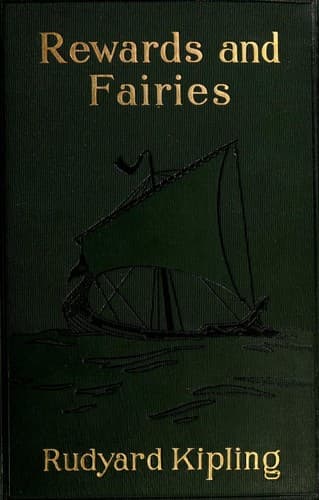
Fairies -- Juvenile fiction; Fantasy literature; Short stories, English; Siblings -- Juvenile fiction
‘When we came to the Dew-ponds all our people were there. The men showed
their knives and told their tale. The sheep guards also had seen
The Beast flying from us. The Beast went west across the river in
packs--howling! He knew the Knife had come to the Naked Chalk at
last--at last! He knew! So my work was done. I looked for my Maiden
among the Priestesses. She looked at me, but she did not smile. She made
the sign to me that our Priestesses must make when they sacrifice to the
Old Dead in the Barrows. I would have spoken, but my Mother’s brother
made himself my Mouth, as though I had been one of the Old Dead in the
Barrows for whom our Priests speak to the people on Midsummer Mornings.’
‘I remember. Well I remember those Midsummer Mornings!’ said Puck.
‘Then I went away angrily to my Mother’s house. She would have knelt
before me. Then I was more angry, but she said, “Only a God would have
spoken to me thus, a Priestess. A man would have feared the punishment
of the Gods.” I looked at her and I laughed. I could not stop my unhappy
laughing. They called me from the door by the name of Tyr himself. A
young man with whom I had watched my first flocks, and chipped my first
arrow, and fought my first Beast, called me by that name in the Old
Tongue. He asked my leave to take my Maiden. His eyes were lowered, his
hands were on his forehead. He was full of the fear of a God, but of me,
a man, he had no fear when he asked. I did not kill him. I said, “Call
the maiden.” She came also without fear--this very one that had waited
for me, that had talked with me, by our Dew-ponds. Being a Priestess,
she lifted her eyes to me. As I look on a hill or a cloud, so she looked
at me. She spoke in the Old Tongue which Priestesses use when they make
prayers to the Old Dead in the Barrows. She asked leave that she might
light the fire in my companion’s house--and that I should bless their
children. I did not kill her. I heard my own voice, little and cold,
say, “Let it be as you desire,” and they went away hand in hand. My
heart grew little and cold; a wind shouted in my ears; my eye darkened.
I said to my Mother, “Can a God die?” I heard her say, “What is it? What
is it, my son?” and I fell into darkness full of hammer-noises. I was
not.’
‘Oh, poor--poor God!’ said Puck. ‘And your wise Mother?’
‘She knew. As soon as I dropped she knew. When my spirit came back
I heard her whisper in my ear, “Whether you live or die, or are made
different, I am your Mother.” That was good--better even than the water
she gave me and the going away of the sickness. Though I was ashamed to
have fallen down, yet I was very glad. She was glad too. Neither of us
wished to lose the other. There is only the one Mother for the one son.
I heaped the fire for her, and barred the doors, and sat at her feet as
before I went away, and she combed my hair, and sang.
‘I said at last, “What is to be done to the people who say that I am
Tyr?”
Public-domain text, read in full here on John Shaqi.
Reviews
Reviews
No reviews yet
Be the first to share your thoughts on this work.
Join the Discussion
Join the discussion
Sign in to leave a comment or review.
Sign InorCreate an account