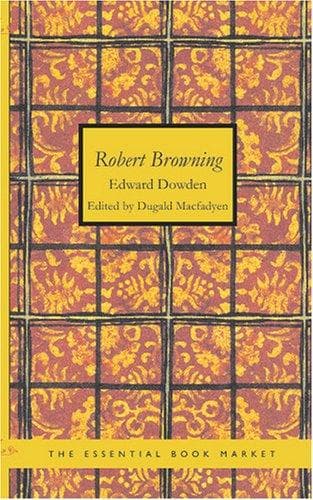
Browning, Robert, 1812-1889; Poets, English -- 19th century -- Biography
As she lies on her pallet, dying "in the good house that helps the poor
to die," she is far withdrawn from the things of time; her life, with
all its pleasures and its pains, seems strange and far away--
Looks old, fantastic and impossible:
I touch a fairy thing that fades and fades.
Two possessions, out of what life has brought, remain with her--the
babe, who while yet unborn had converted her from a sufferer to a
defender, and the friend who has saved her soul. Even motherhood itself
is not the deepest thing in Pompilia's nature. The little Gaetano, whom
she had held in her arms for three days, will change; he will grow
great, strong, stern, a tall young man, who cannot guess what she was
like, who may some day have some hard thought of her. He too withdraws
into the dream of earth. She can never lose him, and yet lose him she
surely must; all she can do is by dying to give him "out-right to God,
without a further care," so to be safe. But one experience of Pompilia's
life was quite out of time, and belongs by its mere essence to eternity.
Having laid her babe away with God, she must not even "think of him
again, for gratitude"; and her last breath shall spend itself in doing
service to earth by striving to make men know aright what earth will for
a time possess and then, forever, heaven--God's servant, man's friend,
the saviour of the weak, the foe of all who are vile--and to the gossips
of Arezzo and of Rome the fribble and coxcomb and light-of-love priest,
Caponsacchi.
Public-domain text, read in full here on John Shaqi.
Reviews
Reviews
No reviews yet
Be the first to share your thoughts on this work.
Elsewhere in the archive
Join the Discussion
Join the discussion
Sign in to leave a comment or review.
Sign InorCreate an account