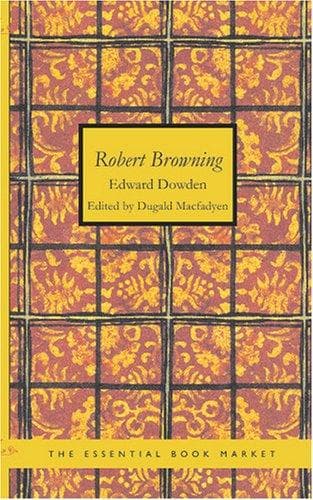
Browning, Robert, 1812-1889; Poets, English -- 19th century -- Biography
Many persons have attempted to describe Browning as he appeared in
society; there is a consensus of opinion as to the energy and cordiality
of his way of social converse; but it is singular that, though some
records of his out-pourings as a talker exist, very little is on record
that possesses permanent value. Perhaps the best word that can be quoted
is that remembered by Sir James Paget--Browning's recommendation of
Bach's "Crucifixus--et sepultus--et resurrexit" as a cure for want of
belief. He did not fling such pointed shafts as those of Johnson which
still hang and almost quiver where they struck. His energy did not
gather itself up into sentences but flowed--and sometimes foamed--in a
tide. Cordial as he was, he could be also vehemently intolerant, and
sometimes perhaps where his acquaintance with the subject of his
discourse was not sufficient to warrant a decided opinion.[121] He
appeared, says his biographer, "more widely sympathetic in his works
than in his life"; with no moral selfishness he was, adds Mrs Orr,
intellectually self-centred; and unquestionably the statement is
correct. He could suffer fools, but not always gladly. Speaking of
earlier days in Italy, T.A. Trollope observes that, while he was never
rough or discourteous even to the most exasperating fool, "the men used
to be rather afraid of Browning." His cordiality was not insincere; but
it belonged to his outer, not his inner self. With the exception of
Milsand, he appears to have admitted no man to his heart, though he gave
a portion of his intellect to many. His friends, in the more intimate
sense of the word, were women, towards whom his feeling was that of
comradeship and fraternal affection without over-much condescension or
any specially chivalric sentiment. When early in their acquaintance Miss
Barrett promised Browning that he would find her "an honest man on the
whole," she understood her correspondent, who valued a good comrade of
the other sex, and had at the same time a vivid sense of the fact that
such a comrade was not so unfortunate as to be really a man.
Public-domain text, read in full here on John Shaqi.
Reviews
Reviews
No reviews yet
Be the first to share your thoughts on this work.
Elsewhere in the archive
Join the Discussion
Join the discussion
Sign in to leave a comment or review.
Sign InorCreate an account