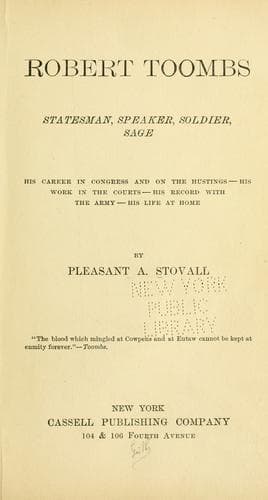
Robert Toombs: Statesman, Speaker, Soldier, SageStovall, Pleasant A.
History
Robert Toombs: Statesman, Speaker, Soldier, Sage
Stovall, Pleasant A.
Toombs, Robert Augustus, 1810-1885
In 1859 he refused to vote to appropriate $500,000 for the improvement
of Buffalo harbor, because he held he had no right to spend the money of
the whole Union for a particular locality; for this reason he voted to
abolish the mint at Dahlonega, in his own State.
Mr. Toombs opposed the policy of buying the outstanding debt at a
premium. He criticised Senator Simon Cameron for asking that the
government give employment to 50,000 laborers out of work. He said,
"Sir, government cannot do it and never did do it. There never was a
government in the world which did not ruin the people they attempted to
benefit by such a course. Governments do not regulate wages."
Senator Toombs contended that the Postal Department stood on a different
footing from the army and navy. Postal service, he thought, was no part
of the national duty. "It is of no more importance to the people of the
United States that this government should carry my letters than that it
should carry my cotton." He claimed that he had some old-fashioned
ideas, but they were innate. "I do not think it right, before God, for
me to make another man pay my expenses."
In discussing the financial report, he said, "You have as much time to
appropriate money intelligently as you have to give it lavishly. While
there is a general cry for retrenchment, when any practical movement is
made, the answer always is that this is not the right time or the right
place. I am afraid we shall never find the right time, or the right
place, until the popular revolution becomes strong enough to send here
men who will do the public business better than we have done it."
CHAPTER XVIII.
ELECTION OF LINCOLN.
In the election of November, 1860, Mr. Lincoln received 1,857,610 votes,
and the combined opposition 2,787,780 votes, the successful candidate
being in a minority of nearly a million votes. The new House of
Representatives was Democratic, and the Senate had not been won over to
the antislavery party. But the trend of Northern politics was
unmistakably toward the extinction of slavery. As Mr. Lincoln said in
his letter to Mr. Stephens: "You think slavery is right and ought to be
extended, while we think it is wrong and ought to be restricted. There,
I suppose, is the rub." Mr. Buchanan's message to Congress was full of
conservative counsel, but the Northern pressure was too strong. His
Cabinet was soon dissolved, and the places of Southern men were taken by
Northern representatives, whose influence was not assuring to Southern
people.
Public-domain text, read in full here on John Shaqi.
Reviews
Reviews
No reviews yet
Be the first to share your thoughts on this work.
Elsewhere in the archive
Join the Discussion
Join the discussion
Sign in to leave a comment or review.
Sign InorCreate an account