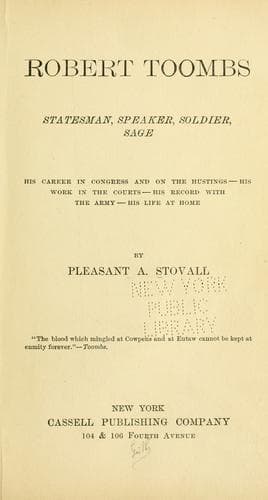
Robert Toombs: Statesman, Speaker, Soldier, SageStovall, Pleasant A.
History
Robert Toombs: Statesman, Speaker, Soldier, Sage
Stovall, Pleasant A.
Toombs, Robert Augustus, 1810-1885
Just before his departure for Congress Mr. Toombs, in response to an
invitation, wrote a conservative letter to his constituents in Danburg,
Wilkes County, Ga. It bore date of December 13, 1860. The General
Assembly of Georgia had unanimously passed a resolution calling for a
State convention to meet on January 16, 1861. Mr. Toombs took the ground
that separation, sooner or later, was inevitable. The time when the
remedy was to be applied was the point of difference. He opposed delay
longer than March 4, but declared that he would certainly yield that
point "to earnest and honest men who are with me in principle but are
more hopeful of redress from the aggressors than I am. To go beyond
March 4, we should require such preliminary measures to be taken as
would, with reasonable certainty, lead to adequate redress, and in the
meantime, we should take care that the delay gives no advantage to the
adversary." Mr. Toombs declared that he believed the policy of Mr.
Lincoln was to ultimately abolish slavery in the States, by driving
slavery out of the Territories, by abrogating Fugitive-slave laws, and
by protecting those who stole slaves and incited insurrections. The only
way to remedy these evils, in the Union, was by such constitutional
amendments as can be neither resisted nor evaded. "If the Republican
party votes for the amendments, we may postpone final action. This will
be putting planks where they are good for something. A cartload of new
planks in the party platform will not redress one wrong nor protect one
right."
As strong and unmistakable as this letter seemed, the great body of the
people of Georgia did not think it sufficiently aggressive. Secession
now amounted to a furor. It was not the work of leaders, but the spirit
which pervaded the ranks of the people, who clamored because events did
not move fast enough. The "minute-men" declared Mr. Toombs' letter was a
backdown. They called him a traitor, and wanted to vote him a tin sword.
Congress, upon reassembling, devoted itself to measures of compromise.
The situation was one of the deepest gravity. In the House a committee
of thirty-three was raised, and in the Senate a committee of thirteen,
to look into the situation. But there was no Henry Clay to interpose,
with tact and broad statesmanship, at the supreme moment.
Twice before in our history, the "Great Pacificator" had proven equal to
a desperate emergency. Adjusting the tariff in 1832 when South Carolina
threatened nullification, he had kept the peace between Calhoun and
Jackson. Proposing his omnibus bill in 1850, he had silenced all calls
for disunion by the territorial concession. Equally lacking was the
example of Webster to face the prejudices of the North and calm the
apprehensions of the South. Perhaps it was because these men had
postponed the conflict then that it reappeared now with irrepressible
power.
Public-domain text, read in full here on John Shaqi.
Reviews
Reviews
No reviews yet
Be the first to share your thoughts on this work.
Elsewhere in the archive
Join the Discussion
Join the discussion
Sign in to leave a comment or review.
Sign InorCreate an account