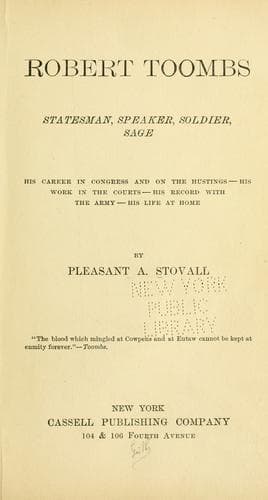
Robert Toombs: Statesman, Speaker, Soldier, SageStovall, Pleasant A.
History
Robert Toombs: Statesman, Speaker, Soldier, Sage
Stovall, Pleasant A.
Toombs, Robert Augustus, 1810-1885
General Toombs' entry into the field, just after the first battle of
Manassas, found the army of the Confederacy flushed with victory, but
badly scattered after the first serious engagement of the war. General
Johnston had declared that even after the decisive advantage at Bull
Run, pursuit was not to be thought of, for his troops were almost as
much disorganized by victory as the Federals by their defeat. Many
soldiers, supposing the war was over, had actually gone home. "Our men,"
said General Johnston, "had in a larger degree the instincts of personal
liberty than those of the North, and it was found very difficult to
subordinate their personal wills to the needs of military discipline."
The battle of Manassas had a powerful effect upon the Northern mind. The
Lincoln Cabinet was seized with fear for the safety of Washington. New
troops were summoned to that city, and the materials for a magnificent
army were placed in the hands of General McClellan, who had succeeded
McDowell, the luckless victim of Manassas. More than one hundred
thousand men were now massed in front of Washington, while Joseph E.
Johnston, with fifty-four thousand, advanced his outposts to
Centreville, and at Munson's Hill Toombs' brigade was in sight of the
national capital. His troops could easily watch the workmen building one
of the wings of the Capitol, and the victorious Confederates, with
prestige in their ranks, were actually flaunting their flag in the face
of Mr. Lincoln. This movement, we are told by good generals, was of no
military value, but it kept the Northern administration in a white heat.
It confused the Union commanders by crossing their counsels with popular
clamor and political pressure, and it crippled McClellan when he finally
moved down the Chesapeake to the peninsula, by detaining a large part of
his force to pacify the authorities in Washington.
When McClellan and Mr. Lincoln were disputing over their change of base,
the military situation was suddenly shifted by the evacuation of
Manassas by the Confederate army, and its retirement first behind the
Rappahannock, then along the Rapidan. Johnston, it seems, wanted to be
nearer his base, and on the 8th of March skillfully managed his
withdrawal, so that the enemy had no idea of his movements. General
Toombs' brigade started in retreat from Centreville. He did not relish
this movement. He writes home from Culpepper:
Public-domain text, read in full here on John Shaqi.
Reviews
Reviews
No reviews yet
Be the first to share your thoughts on this work.
Elsewhere in the archive
Join the Discussion
Join the discussion
Sign in to leave a comment or review.
Sign InorCreate an account