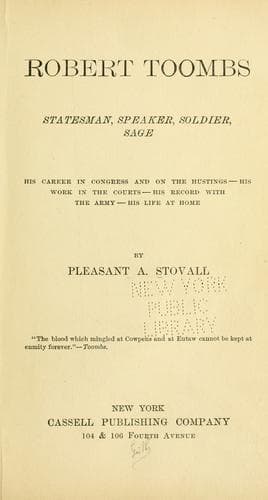
Robert Toombs: Statesman, Speaker, Soldier, SageStovall, Pleasant A.
History
Robert Toombs: Statesman, Speaker, Soldier, Sage
Stovall, Pleasant A.
Toombs, Robert Augustus, 1810-1885
In February, 1859, the Army Appropriation bill had come up before the
United States Senate. Mr. Toombs attacked, and Mr. Davis defended the
whole system. Mr. Toombs contended that the compensation of army
officers was too great. It was more than the same talent could command
in any other walk of life. It was upon a wrong basis. "You take a boy of
sixteen and send him to West Point, and when he comes out you give him
$1400 a year. In the course of a few years you carry him up to $3000,
$6000, or $8000. Take the general employment of the youths of the
country who are educated at the different colleges for all civil
purposes. You may have the highest amount of genius and intellect, and
you get nothing like such average there. It will take them many years to
make that much money." Mr. Toombs declared that a brigadier general's
commission was higher than that of a United States Senator. "I think,"
said he, "it requires as great qualifications to govern this country as
it does to be a brigadier general." Officers had increased far beyond
the wants of the country. Members of Congress appoint cadets for the
different districts; "they are generally associated in some way, as
brothers, sons, or cousins, with the governing power." He thought a
salary of $600 or $900 for the West Point graduates enough. According
to the way army commissions were valued in England, the commission of a
lieutenant who graduated at West Point could not be worth less than
$50,000. The pay of a captain was higher than that of a judge. That
position required the highest ability and integrity, and the average
salary of a judge was but $2000, without traveling expenses. Mr. Toombs
contended that West Point men seldom reflected any opinions but those of
the government which employed them. They seldom sympathized with the
people, and he wanted a government of the people. "You take a boy to
West Point," he said, "give him quarters, and fuel, and clothes, and
maintain him, and you say he has rendered service. When the citizens of
this country send their sons to college they pay their expenses or work
their way through; but when a boy is carried to West Point he is taken
care of; a house is provided for him; clothes are provided for him;
instructors are provided for him, and that is called being in service. I
lay down the proposition that the true theory of wages, if you employ
these people to keep the peace, is exactly the same--a constable's
pay--you ought to pay them what they can be had for."
Public-domain text, read in full here on John Shaqi.
Reviews
Reviews
No reviews yet
Be the first to share your thoughts on this work.
Elsewhere in the archive
Join the Discussion
Join the discussion
Sign in to leave a comment or review.
Sign InorCreate an account