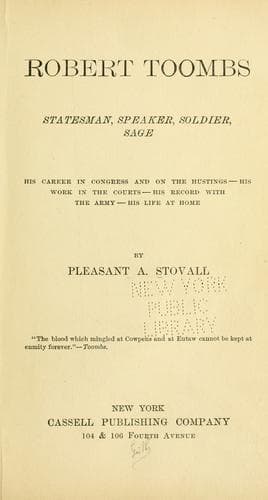
Robert Toombs: Statesman, Speaker, Soldier, SageStovall, Pleasant A.
History
Robert Toombs: Statesman, Speaker, Soldier, Sage
Stovall, Pleasant A.
Toombs, Robert Augustus, 1810-1885
At the siege of Yorktown in the early part of May, 1862, General Toombs
commanded a division consisting of his own and Semmes' brigades. He had
2357 men in his own and 2342 in Semmes' brigade, making about 4700
troops in line. During this siege General Magruder reports that General
Toombs supported Cobb's brigade, and promptly and energetically led the
remainder of his command under fire, arriving just before the enemy
ceased their attack, and in time to share its danger. General Magruder
had only 11,000 men under him in the peninsula, and General Huger but
8000, to oppose McClellan's march with 80,000. Johnston and Lee both
pronounced the peninsula untenable, and on the 4th of May Yorktown was
evacuated.
After the retreat from the peninsula, General Johnston concentrated his
entire army behind the Chickahominy River, sixteen miles from Richmond.
On the 12th of May General Toombs writes home that his command near the
Chickahominy was "resting easily after a disagreeable march from
Yorktown. I hear that there is great consternation in Richmond.... The
loss of New Orleans gives us a terrible blow, and, followed by Norfolk,
makes it necessary for us to strike a decisive blow somewhere." On 19th
of May, 1862, he writes home from the camp near Richmond:
We seem to have come up here to defend this city. You ask
me my opinion of the present state of the country. It is
bad enough. The utter incompetency of Mr. Davis and his
West Point generals have brought us to the verge of ruin.
If McClellan is unwise enough to fight us here, we shall
whip and drive him out of Virginia.... As to Richmond, it
will never be taken while this army is here.
General Toombs' estimate of the army and of the futility of an attack
from McClellan was justified when, after the 26th of June, the Army of
the Potomac, almost in sight of the spires of Richmond, was forced to
reel back, in the deadly clinch of a seven days' combat, to the James
River. The Confederate army changed its position from one of retreat to
a brilliant and aggressive policy, and the subtle tactics of Johnston
gave way to the bold strokes of Lee. The South was thrilled with
victory.
General Toombs frequently referred to the incompetency of Mr. Davis. The
letters which have just been quoted were written to his wife, and were
not made public then, but he did not hesitate to express his opinion
openly. Jefferson Davis and Mr. Toombs had some differences while the
former was Secretary of War under Franklin Pierce and Mr. Toombs was in
the Senate. Mr. Toombs believed that President Davis was too partial to
West Point, at which school Mr. Davis had been trained, and that in his
management of the army he showed the tenacity of a martinet rather than
the breadth of a statesman.
Public-domain text, read in full here on John Shaqi.
Reviews
Reviews
No reviews yet
Be the first to share your thoughts on this work.
Elsewhere in the archive
Join the Discussion
Join the discussion
Sign in to leave a comment or review.
Sign InorCreate an account