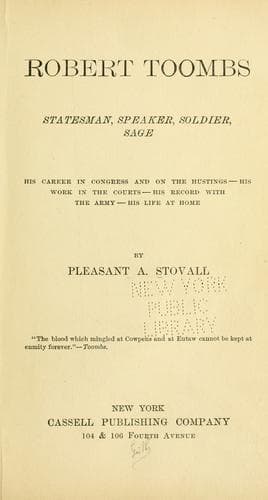
Robert Toombs: Statesman, Speaker, Soldier, SageStovall, Pleasant A.
History
Robert Toombs: Statesman, Speaker, Soldier, Sage
Stovall, Pleasant A.
Toombs, Robert Augustus, 1810-1885
General Hill was a good man and a brave soldier. His devotion to the
Confederate cause was undoubted, but his zeal sometimes made him harsh,
and more than once he placed himself in the position of reflecting upon
the conduct of others. On one occasion at the battle of Chickamauga,
where General Hill was in command of the extreme right of the
Confederate line, on the second day of the battle information was
brought to him of the sudden and unexpected advance of a strong Federal
force against his line. It proved to be the division of the Federal
General Gordon Granger. General Hill and General W. H. T. Walker, who
commanded two divisions under General Hill, proceeded at once to the
threatened point, to ascertain the situation of affairs, accompanied by
some members of their staff. Arrived at a point where this new arrival
of Federal forces could be seen, General Walker deferred to General Hill
and asked him, "What do you wish me to do?"
"What do I want you to do?" said Hill with severity, and even with
something like a snarl, "I want you to fight."
General Walker flushed up in a moment. He was not a man to deserve any
reflection upon his courage or to bear it when offered. No man in the
old army had a higher and more deserved reputation for dashing courage.
He had been desperately wounded in Florida, and again wounded, supposed
to be mortally, in leading the assault on Chapultepec in the Mexican
War, and had, on many occasions, given undoubted evidence of his valor
and fidelity. He answered hotly, "Of course I will fight; you know that,
General Hill, well enough; but, by God! sir, there are two ways of
fighting, one to whip and the other to get whipped."
The point was a good one. Major Joseph B. Cumming, chief of General
Walker's staff, who related this incident, says it had the desired
effect.
When Longstreet marched against Pope he stationed General Toombs'
brigade to guard one of the fords of the Rapidan. Toombs was absent at
the time and when he rode up ordered them back to camp. General
Longstreet heard of Toombs making stump speeches and "referring in
anything but complimentary terms of his commander." He sent General
Toombs to Gordonsville. Afterward he received an apology from Toombs and
directed him to join his command. ["]As we were preparing for the
charge at Manassas (second battle), Toombs got there, riding rapidly
with his hat in his hand, and was much enthused. I was just sending a
courier to his command with a dispatch. 'Let me take it,' he exclaimed.
'With pleasure,' I responded, and handed him the paper. He put spurs to
his horse and dashed off, accompanied by his courier. When he rode up
and took command of his brigade there was wild enthusiasm, and,
everything being ready, an exultant shout was sent up, and the men
sprang to the charge. I never had any more trouble with Toombs. We were
afterward warm personal friends."
Public-domain text, read in full here on John Shaqi.
Reviews
Reviews
No reviews yet
Be the first to share your thoughts on this work.
Elsewhere in the archive
Join the Discussion
Join the discussion
Sign in to leave a comment or review.
Sign InorCreate an account