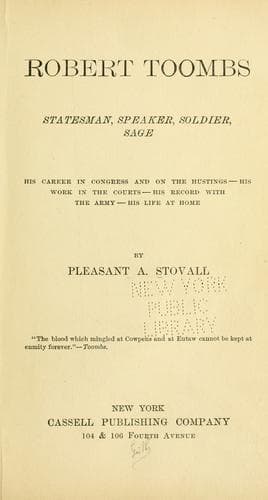
Robert Toombs: Statesman, Speaker, Soldier, SageStovall, Pleasant A.
History
Robert Toombs: Statesman, Speaker, Soldier, Sage
Stovall, Pleasant A.
Toombs, Robert Augustus, 1810-1885
On the 30th of August, 1862, Hon. A. H. Stephens wrote to Mrs. Toombs
that General Toombs was still at Gordonsville. He said:
How long he will remain, I do not know. I thought at first
that it would only be for a day or two, or until General
Longstreet could receive and reply to two notes he had
written, explaining to my mind very fully and
satisfactorily his acts and conduct, which, it seems to me,
General Longstreet had misunderstood. Such is still my
opinion, and yet I may be mistaken. I do not know much of
General Longstreet. I only know that General Toombs, who
does know him, always expressed very high admiration of him
as an officer.
At the second battle of Manassas, August 29, 1862, Toombs' brigade in
Jones' division held the rear of Longstreet's corps. Early in the
morning the brigade took up the march in the direction of the old
battlefield of Manassas, where heavy firing was heard. Arriving at noon
it was stationed on the extreme right, or upon the Manassas Gap
railroad. The brigades formed in echelon. General Longstreet in his
published report commended especially General Toombs for gallant conduct
at Manassas Plain.
General D. R. Jones, in his report of Manassas, says:
General Toombs, released from arrest, under which he had
been since the 18th of August, came upon the field shortly
after his brigade went in under fire and accompanied it in
action.
Captain H. L. French, of the 17th Georgia Regiment, says: "Soon after
our engagement, to our great satisfaction, we unexpectedly met our
gallant commander, Brigadier General Robert Toombs, who, anticipating
the fight, had ridden hard all day. He was greeted with hearty cheers,
and said, 'Boys, I am proud of the report given of you by General Jones.
I could not be with you to-day, but this was owing to no fault of mine.
To-morrow I lead you.'"
One report of this engagement declares that as Toombs dashed into the
fire and joined his men, he waved his hat and shouted, "Go it, boys! I
am with you again. Jeff Davis can make a general, but it takes God
Almighty to make a soldier!"
The expulsion of Pope only accelerated the momentum of the Army of
Northern Virginia. From the front of Richmond, the theater of operations
was transferred at once to the front of Washington, and the Union army
was again on the defensive. General Lee, freed from the necessity of
guarding the Confederate capital, resolved to invade Maryland. He
reasoned that the prestige of the invasion would advance the cause of
the young nation abroad; that it would relieve Virginia from incursions
during the winter, and that the presence of the army in Maryland would
raise the standard of revolt and cause the liberation of that State from
the Union cause. Lee's army, however, was not equal to such an
expedition. It was not well clothed or armed, and barely numbered
40,000, while McClellan had 80,000.
Public-domain text, read in full here on John Shaqi.
Reviews
Reviews
No reviews yet
Be the first to share your thoughts on this work.
Elsewhere in the archive
Join the Discussion
Join the discussion
Sign in to leave a comment or review.
Sign InorCreate an account