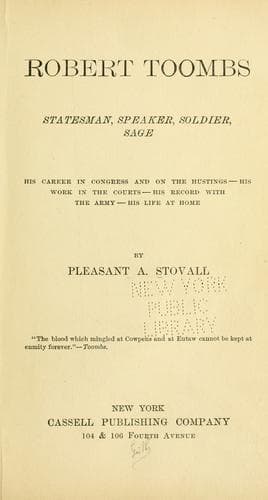
Robert Toombs: Statesman, Speaker, Soldier, SageStovall, Pleasant A.
History
Robert Toombs: Statesman, Speaker, Soldier, Sage
Stovall, Pleasant A.
Toombs, Robert Augustus, 1810-1885
General Toombs was not a trained soldier, but he had some fine points of
a great commander. He was the soul of energy and common sense. He was
bold, dashing, magnetic. He had the quality of infusing his spirit into
his men. His quick mind seized the points of a campaign, and his
intellect was broad and overmastering. It is related of him that one day
in Virginia he hurried to the rear for a conference with Jefferson
Davis, to which the President had summoned him, upon some point of civil
administration. This business over, he dashed back to the front, where
he had an engagement with General Lee over a plan of attack. General
Longstreet said Toombs had the kindling eye and rare genius of a
soldier, but lacked the discipline of a military man. This was the
serious flaw in his character. He had what General Johnston declared was
the great drawback about the Southern soldier, "a large endowment of the
instinct of personal liberty," and it was difficult to subordinate his
will to the needs of military discipline. He had been accustomed to
priority, and in whatever company, under whatever conditions he found
himself, his had been the part to lead and to rule. As Colonel Thomas W.
Thomas had said of him, "Toombs has always been the big frog in the
pond." Men conceded to him this prestige. Under the cast-iron rule of
the army he found himself subordinated to men intellectually beneath
him, but trained and skilled in the art of war. He was swift to detect
error, and impatient in combating blunder. The rule of mediocrity, the
red tape of the service, the restraints of the corps, the tactics of the
field galled his imperious spirit. He commanded his brigade as he had
represented his State in the Senate--as a sovereign and independent
body, and like the heroic Helvetian had blazoned on his crest, "No one
shall cross me with impunity."
Robert Toombs made a mistake in sinking himself in the routine of a
brigade commander. He should have taken the War Department, or, like
Pitt, have pushed the war from the floor of the Senate. Swinton says
that Abraham Lincoln brought the habits of a politician to military
affairs, in which their intrusion can only result in confusion of just
relations. There is ineradicable antagonism between the maxims which
govern politics and those which govern war.
Public-domain text, read in full here on John Shaqi.
Reviews
Reviews
No reviews yet
Be the first to share your thoughts on this work.
Elsewhere in the archive
Join the Discussion
Join the discussion
Sign in to leave a comment or review.
Sign InorCreate an account