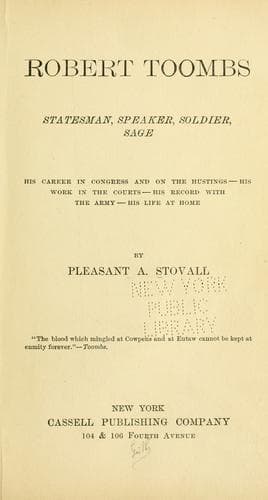
Robert Toombs: Statesman, Speaker, Soldier, SageStovall, Pleasant A.
History
Robert Toombs: Statesman, Speaker, Soldier, Sage
Stovall, Pleasant A.
Toombs, Robert Augustus, 1810-1885
During General Toombs' absence in the field, he opposed the Conscript
Acts of the Confederate administration. He believed them arbitrary and
unjust. He considered that this was a tendency toward centralization
which the Confederate Government was fighting; that it placed too much
power in the hands of one man; that it was deadly to States' Rights and
personal liberty, and that it would impair the efficiency of the army by
lowering its patriotism. The champion of this anti-administration policy
in Georgia was Linton Stephens, the brother of the vice president.
Toombs in the field, the elder Stephens in Congress, and Linton Stephens
in the Georgia Legislature, fought the Conscription and Impressment
Acts. Hon. Joseph E. Brown, the war Governor of Georgia, was also a
vigorous opponent of this policy. This influence gave rise, in the early
part of 1864, to the Peace Resolutions of Linton Stephens, who sustained
Governor Brown in his policy, to inaugurate State action for "the
preservation of rights and the attainment of peace." Linton Stephens, in
a strong letter to General Toombs at that time, called attention to the
fact that since the war began neither side had made any effort to stop
the effusion of blood. He believed that the professional soldiers and
West Point generals would never permit the cessation of hostilities.
Such men, he thought, would not, in human nature, desire peace. "How can
it be explained," he wrote, "that both governments have fought on during
these long years of blood and tears and desolation, without either one
offering terms of peace, and with both running a swift race of rivalry
in usurping the most despotic power under the ever-recurring and false
plea of necessities of war? Have both governments formed designs that
cannot be accomplished in peace, and which seek opportunity and shelter
in the confusion and panic of war?"
Mr. Linton Stephens was a leading lawyer and legislator in Georgia. He
was a man of great ability. He had started the practice of law in the
office of Robert Toombs, and had been a political follower and close
friend of the great Georgian. He had served upon the bench of the
Supreme Court of his State, and at the close of the war his political
influence was probably greater than that of any man at home. He was
fearless, inflexible, high-toned, and full of power. He did not hesitate
to condemn the legislation asked for by Mr. Davis, and joined Mr. Toombs
in opposing the appointment of General Bragg as supervisor of all
military operations. Mr. Stephens believed that the next step after the
Impressment Act would be the organization of all labor into a military
system under government control.
Public-domain text, read in full here on John Shaqi.
Reviews
Reviews
No reviews yet
Be the first to share your thoughts on this work.
Elsewhere in the archive
Join the Discussion
Join the discussion
Sign in to leave a comment or review.
Sign InorCreate an account