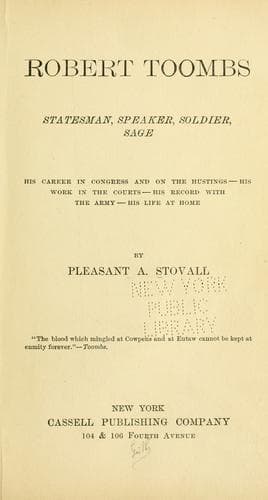
Robert Toombs: Statesman, Speaker, Soldier, Sage — John Shaqi
Robert Toombs: Statesman, Speaker, Soldier, SageStovall, Pleasant A.
History
Robert Toombs: Statesman, Speaker, Soldier, Sage
Stovall, Pleasant A.
Toombs, Robert Augustus, 1810-1885
Although Mr. Toombs often appeared in courts to attend to business
already in his charge, he gave out that he would not engage in any new
causes which might interfere with his Congressional duties. The
absorbing nature of public business from 1850 to 1867 withdrew him from
the bar, and the records of the Supreme Court of Georgia have only about
twenty-five cases argued by him in that time. Some of these were of
commanding importance, and the opinions of the Justices handed down in
that time bear impress of the conclusiveness of his reasoning and the
power of his effort before that tribunal. Judge E. H. Pottle, who
presided over the courts of the Northern Circuit during the later years
of Toombs's practice, recalls a celebrated land case when Robert Toombs
was associated against Francis H. Cone--himself a legal giant. Toombs's
associate expected to make the argument, but Cone put up such a powerful
speech that it was decided that Toombs must answer him. Toombs
protested, declaring that he had been reading a newspaper, and not
expecting to speak, had not followed Judge Cone. However, he laid down
his paper and listened to Cone's conclusion, then got up and made an
overmastering forensic effort which captured Court and crowd.
The last appearance Toombs ever made in a criminal case was in the
Eberhart case in Oglethorpe County, Ga., in 1877. He was then
sixty-seven years of age, and not only was his speech fine, but his
management of his case was superb. He had not worked on that side of the
court for many years, but the presiding Judge, who watched him closely,
declared that he never made a mistake or missed a point.
It was during a preliminary hearing of this case that Toombs resorted to
one of his brilliant and audacious motions, characteristic of him. The
State wanted to divide the case and try the principals separately.
Father and son were charged with murder. The defense objected, but was
overruled by the Court. General Toombs then sprung the point that Judge
Pottle was not qualified to preside, on the ground of a rumor that he
had selected the men of the jury panel instead of drawing them. Toombs
further argued that the Court was not competent to decide the question
of fact. Judge Pottle vacated the bench and the clerk of court called
Hon. Samuel H. Hardeman to preside. Toombs and Benjamin H. Hill, his
assistant, contended that the clerk had no right to appoint a judge.
Judge Hardeman sustained the point and promptly came down, when Judge
Pottle resumed the bench and continued the case--just the result that
Toombs wanted. This case attracted immense comment, and in the
Constitution of 1877 a provision was made, growing out of this incident,
providing for the appointment of judges _pro hac vice_.
Public-domain text, read in full here on John Shaqi.
Reviews
Reviews
No reviews yet
Be the first to share your thoughts on this work.
Join the Discussion
Join the discussion
Sign in to leave a comment or review.
Sign InorCreate an account