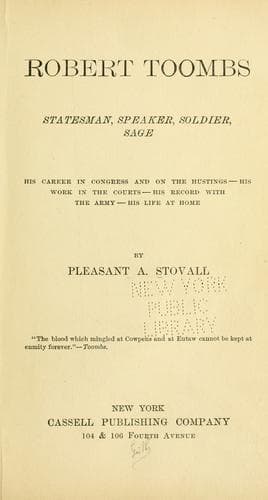
Robert Toombs: Statesman, Speaker, Soldier, SageStovall, Pleasant A.
History
Robert Toombs: Statesman, Speaker, Soldier, Sage
Stovall, Pleasant A.
Toombs, Robert Augustus, 1810-1885
Lieutenant Irvin never saw General Toombs again until 1868. He himself
was an officer of the Irvin artillery, Cutts' battalion, being a part of
Walker's artillery in Longstreet's corps. Entering the army at seventeen
years of age, Charles E. Irvin was a veteran at twenty-one. He was
brave, alert, tender, and true. He recalls that when his company joined
the army in Richmond, Robert Toombs, then Secretary of State, gave them
a handsome supper at the Exchange Hotel. "I remember," said he, "with
infinite satisfaction, that during the seven months I accompanied
General Toombs, in the closest relations and under the most trying
positions, he was never once impatient with me." Frequently, on this
long and perilous journey, Toombs would say; "Well, my boy! suppose the
Yankees find us to-day; what will you do?" "General, you say you won't
be taken alive. I reckon they will have to kill me too."
General Toombs often declared that he would not be captured.
Imprisonment, trial, and exile, he did not dread; but to be carried
about, a prize captive and a curiosity through Northern cities, was his
constant fear. He was prepared to sell his life dearly, and there is no
doubt but that he would have done so.
During all these trying days, Toombs rode with the grace and gayety of a
cavalier. He talked incessantly to his young companion, who eagerly
drank in his words. He fought his battles over again and discussed the
leaders of the Civil War in his racy style. He constantly predicted the
collapse of the greenback system of currency, and speculated
facetiously each day upon the chances of capture. He calculated shrewdly
enough his routes and plans, and when he found himself on _terra firma_,
it was under the soft skies of the Antilles with a foreign flag above
him.
CHAPTER XXV.
WITHOUT A COUNTRY.
From Cuba General Toombs proceeded to Paris. It was early in July before
he reached his new stopping place. He found himself somewhat restricted
in funds, as he had not had time to turn his property into gold to make
his trip abroad. It is related that just after the departure of the
famous "specie train," through Washington in the wake of Mr. Davis'
party, a Confederate horseman dashed by the residence of General Toombs
and threw a bag of bullion over the fence. It was found to contain five
thousand dollars, but Toombs swore he would not even borrow this amount
from his government. He turned it over to the authorities for the use of
disabled Confederate soldiers, and hurriedly scraped up what funds he
could command in case he should be compelled to fly. Arriving in Paris,
General Toombs succeeded in selling one of his plantations, realizing
about five dollars an acre for it. He used to explain to the astounded
Frenchmen, during his residence abroad, that he ate an acre of dirt a
day.
Public-domain text, read in full here on John Shaqi.
Reviews
Reviews
No reviews yet
Be the first to share your thoughts on this work.
Elsewhere in the archive
Join the Discussion
Join the discussion
Sign in to leave a comment or review.
Sign InorCreate an account