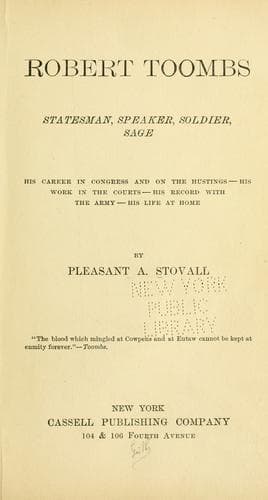
Robert Toombs: Statesman, Speaker, Soldier, SageStovall, Pleasant A.
History
Robert Toombs: Statesman, Speaker, Soldier, Sage
Stovall, Pleasant A.
Toombs, Robert Augustus, 1810-1885
General Toombs repaired to Enghien, where he took a course of sulphur
baths for the benefit of his throat. Constant exposure with the army and
in his flight had brought on his old enemy, the asthma. He had been a
healthy man, having long passed the limit of manhood before he tasted
medicine. Late in life, an attack of scarlet fever left his throat in a
delicate condition.
Mrs. Toombs joined him in Paris in July, 1865, and he passed eighteen
months quietly with her in Europe. It was in marked contrast to his tour
in 1855, when, as United States Senator, he had gone from place to
place, observed, honored, and courted. He was now an exile without a
country. He had seen his political dreams wiped out in blood and his
home in the hands of the enemy. From the dignity and power of a United
States Senator and a possible aspirant to the Presidency, he had been
branded as a conspirator, and forced, like Mirabeau, to seek shelter in
distant lands.
France was, at that time, in a state of unrest. Louis Napoleon was
watching with anxiety the eagles of Prussia hovering over the German
Confederation. Austria had already succumbed to Prussian power, and
Napoleon had been blocked in his scheme to secure, from this disorder,
his share of the Rhenish provinces. Toombs, who had fled from a restored
Union in America, now watched the march of consolidation in Europe, and
predicted its final success.
General Toombs was an object of interest in Europe. His position toward
the American government prevented his public recognition by the rulers,
but he used to relate with zest his interviews with Carlyle, the Empress
Eugenie, and other notables. He was a man to attract attention, and his
talk was fascinating and bright.
He was sometimes sought in a legal way by prominent financiers, who
asked his opinions upon fiscal matters in America. There is no doubt but
that, like Judah P. Benjamin, he could have built up a large practice
abroad, had he cared to do so; but permanent residence away from home
was entirely out of his mind.
In December, 1866, General and Mrs. Toombs received a cable message
telling them of the death of their only daughter, Mrs. Dudley M. DuBose,
in Washington, Ga. Mrs. Toombs at once returned home, leaving the
grief-stricken father alone in Paris. Anxious to go back with her, he
was advised that matters were still unsettled in the United States. The
impeachment of Andrew Johnson was in progress, and his conviction meant
restored martial law for the South. So the days were full of woe for the
lonely exile.
Public-domain text, read in full here on John Shaqi.
Reviews
Reviews
No reviews yet
Be the first to share your thoughts on this work.
Elsewhere in the archive
Join the Discussion
Join the discussion
Sign in to leave a comment or review.
Sign InorCreate an account