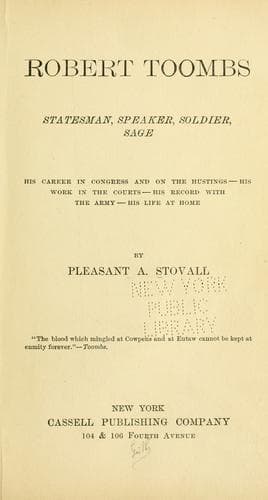
Robert Toombs: Statesman, Speaker, Soldier, SageStovall, Pleasant A.
History
Robert Toombs: Statesman, Speaker, Soldier, Sage
Stovall, Pleasant A.
Toombs, Robert Augustus, 1810-1885
Robert Toombs cast his first vote for Andrew Jackson in 1832. He
abandoned the Union Democratic-Republican party, however, after the
proclamation and force bill of the Administration and joined the States'
Rights Whigs. When young Toombs was elected to the General Assembly of
Georgia in October, 1837, parties were sharply divided. The Democrats,
sustained by the personal popularity of "Old Hickory," were still
dominant in the State. The States' Rights Whigs, however, had a large
following, and although not indorsing the doctrines of Calhoun, the
party was still animated by the spirit of George M. Troup. This
statesman, just retired from public life, had been borne from a sick-bed
to the United States Senate Chamber to vote against the extreme measures
of President Jackson. The Troup men claimed to be loyal to the
Constitution of their country in all its defined grants, and conceded
the right of the Chief Magistrate to execute the office so delegated,
but they resisted what they believed to be a dangerous latitude of
construction looking to consolidated power. Robert Toombs was not a
disciple of Calhoun. While admiring the generalities and theories of the
great Carolinian, the young Georgian was a more practical statesman. The
States' Rights Whigs advocated a protective tariff and a national bank.
They believed that the depreciation of the currency had caused the
distress of the people in the panic of 1837, and no man in this stormy
era more vigorously upbraided the pet-bank and sub-treasury system than
Robert Toombs. He introduced a resolution in the legislature declaring
that President Van Buren had used the patronage of the government to
strengthen his own party; that he had repudiated the practices and
principles of his patriotic antecedents, and "had sought out antiquated
European systems for the collection, safe keeping, and distribution of
public moneys--foreign to our habits, unsuited to our conditions,
expensive and unsafe in operation." Mr. Toombs contended, with all the
force that was in him, that a bank of the United States, properly
regulated, was "the best, most proper and economical means for handling
public moneys." Robert Toombs would not have waited until he was
twenty-seven years of age before entering public life, had not the
sentiment of his county been hostile to his party. Wilkes had been a
Union county, but in 1837 it returned to the lower house two Democrats,
and Robert A. Toombs, the only Whig. Nothing but his recognized ability
induced the people to make an exception in his favor. Besides his
reputation as an orator and advocate, Toombs had just returned from the
Creek war, where he had commanded a company and served under General
Winfield Scott in putting down the insurrection of Neahmatha, the Indian
chief. He now brought to public life the new prestige of a soldier.
After this, "Captain Toombs" was never defeated in his county. He was
returned at the annual elections in 1839, 1840, 1842, and 1843--and
Public-domain text, read in full here on John Shaqi.
Reviews
Reviews
No reviews yet
Be the first to share your thoughts on this work.
Join the Discussion
Join the discussion
Sign in to leave a comment or review.
Sign InorCreate an account