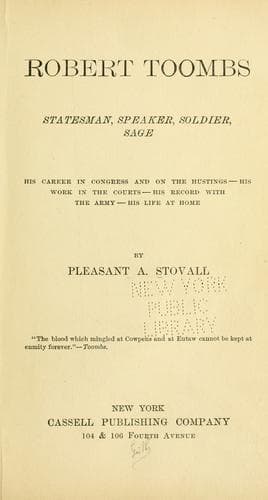
Robert Toombs: Statesman, Speaker, Soldier, SageStovall, Pleasant A.
History
Robert Toombs: Statesman, Speaker, Soldier, Sage
Stovall, Pleasant A.
Toombs, Robert Augustus, 1810-1885
During the proceedings of this convention an effort was made to open the
courts to review the cases of certain outlawed bonds, which the
legislature had refused to pay, and which the people had repudiated by
constitutional amendment. Impressed by the conviction that certain
classes of these bonds should be paid, the venerable president of the
convention surrendered the chair and pled from his place on the floor
for a judicial review of this question.
No sooner was this solemn and urgent appeal concluded than General
Toombs bounded to the floor. He declared with energy that no power of
heaven or hell could bind him to pay these bonds. The contract was one
of bayonet usurpation. Within a few days the legislature had loaded the
State down with from ten to fifteen millions of the "bogus bonds."
The term "repudiation" was distasteful to many. The bondholders did not
relish it; but he thought it was a good honest word. No one was bound by
these contracts, because they were not the acts of the people. "I have
examined all the facts pertaining to these claims," said Toombs, "and
looking to nothing but the State's integrity, I affirm that the matter
shall go no further without my strenuous opposition. The legislature has
again and again declared the claims fraudulent. The people have spoken.
Let the bonds die." The convention agreed with Toombs.
On the 16th of August the convention, then in the midst of its labors,
confronted a crisis. The appropriation of $25,000 made by the
legislature to meet the expenses of the convention had been exhausted,
and the State Treasurer notified the president that he could not honor
his warrants any further. This was a practical problem. The work mapped
out had not been half done. Many of the delegates were poor men from the
rural districts and were especially dependent upon their _per diem_
during the dull summer season. To proceed required about $1000 per day.
To have crippled this body in its labors would have been a public
calamity. To check upon the public treasury beyond the limit fixed by
law involved a risk which the State Government, not too friendly toward
the convention at best, declined to assume. To raise the money outside
by a private loan presented this risk, that in the case of the rejection
of the constitution, then in embryo, the lender might find himself the
holder of an uncertain claim. The convention, however, was not left long
in doubt. With a heroic and patriotic _abandon_, General Toombs declared
that if Georgia would not pay her debts, he would pay them for her.
Selling a dozen or two United States bonds, he placed the proceeds to
the credit of the president of the convention, who was authorized in
turn to issue notes of $1000 each and deposit them with General Toombs.
The act was spontaneous, whole-souled, dramatic. It saved the convention
and rehabilitated the State with a new constitution. By a rising and
unanimous vote General Toombs was publicly thanked for his
Public-domain text, read in full here on John Shaqi.
Reviews
Reviews
No reviews yet
Be the first to share your thoughts on this work.
Elsewhere in the archive
Join the Discussion
Join the discussion
Sign in to leave a comment or review.
Sign InorCreate an account