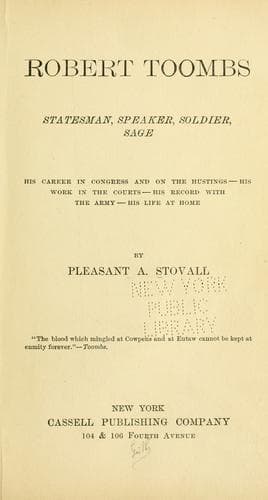
Robert Toombs: Statesman, Speaker, Soldier, SageStovall, Pleasant A.
History
Robert Toombs: Statesman, Speaker, Soldier, Sage
Stovall, Pleasant A.
Toombs, Robert Augustus, 1810-1885
public-spirited act, and the old man, alone remaining in his seat in the
convention hall, covered his face with his hands, and shed tears during
this unusual demonstration.
When the convention had under review the bill of rights, General Toombs
created a breeze in the proceedings by proposing a paragraph that the
legislature should make no irrevocable grants of special privileges or
immunities. The proposition received a rattling fire from all parts of
the house. Governor Jenkins assailed it on the floor as dangerous to
capital and fatal to public enterprise. It was argued that charters were
contracts, and that when railroads or other interests were put upon
notice that their franchise was likely to be disturbed, there would be
an overthrow of confidence and development in Georgia. This was the
first intimation of the master struggle which General Toombs was about
to make, an advance against the corporations all along the line. It was
the picket-firing before the engagement.
General Toombs had made a study of the whole railroad question. He was
a master of the law of corporations. He maintained a peculiar attitude
toward them. He never invested a dollar in their stock, nor would he
accept a place at their council boards. He rarely ever served them as
attorney. When the General Assembly resolved to tax railroads in
Georgia, the State selected General Toombs to prosecute the cases. In
1869 he had argued the Collins case against the Central Railroad and
Banking Company, in which the court had sustained his position that the
proposed action of the Central Road in buying up the stock of the
Atlantic and Gulf Railroad, to control that road, was _ultra vires_. He
had conducted the case of Arnold DuBose against the Georgia Railroad for
extortion in freight charges.
The principles he had gleaned from this laborious record made him
resolve to place restrictions upon corporate power in the new
constitution. The time was ripe for this movement. The Granger
legislation in the West had planted in the organic law of Illinois,
Ohio, and Missouri the policy of government control over the railroads.
The statutes of Pennsylvania also reflected the same principles, and the
Supreme Court of the United States had decided this great case on the
side of the people. General Toombs was master of the legislation on this
subject in England, and had studied the American reports on the right
and duty of the state to regulate railroad companies. He declared, in
proposing this new system, that these laws had been adopted by the most
enlightened governments of the world. "From the days of the Roman Empire
down to the present time," said Toombs, "it has never been denied that
the state has power over the corporations."
Public-domain text, read in full here on John Shaqi.
Reviews
Reviews
No reviews yet
Be the first to share your thoughts on this work.
Elsewhere in the archive
Join the Discussion
Join the discussion
Sign in to leave a comment or review.
Sign InorCreate an account