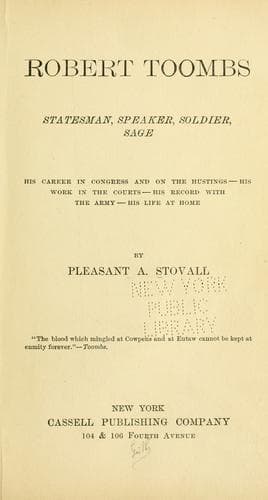
Robert Toombs: Statesman, Speaker, Soldier, SageStovall, Pleasant A.
History
Robert Toombs: Statesman, Speaker, Soldier, Sage
Stovall, Pleasant A.
Toombs, Robert Augustus, 1810-1885
General Toombs resided in a three-story frame house in Washington, built
after the manner of the olden time, with the spacious piazza, heavy
columns, the wide door, and the large rooms. He lived in ease and
comfort. He was an early riser, and after breakfast devoted himself to
business or correspondence. At midday he was accessible to visitors, and
rarely dined alone. In the afternoon he walked or drove. At night he sat
in his arm-chair at his fireside, and in his lips invariably carried an
unlit cigar. Smoking did not agree with him. While in Europe he
delighted to test the tobacco of the different countries, but the
practice always gave him pain above the eyes. His last attempt was in
the army of Virginia. Convinced that smoking injured him, he never
resumed it. Fond of his dry smoke, he had a peculiar cigar made to
order, very closely wrapped, with fine tobacco.
General Toombs made frequent trips away from home, even during the
latter part of his life. The State retained his services in important
cases. One of his last public acts was the prosecution of certain
railway companies for back taxes. He recovered thousands of dollars to
the State. He was summoned to Atlanta in 1880 to prosecute a defaulting
State treasurer. He appeared very feeble, but his speech was a model of
clearness and logic. During the latter part of his life there was a
return of his early fault of quick, nervous, compressed speech. He
grasped only the great hillocks of thought and left the intervening
ground to be filled by the listener. His terse, rapid style was
difficult to follow. As a presiding judge said, "His leaps are like a
kangaroo's, and his speech gave me the headache." But his argument in
the Jack Jones case was a model of eloquence and convincing law. A large
number of friends attended the court, convinced that General Toombs was
nearing the end of his great career, and were astounded at the manner
in which he delivered his argument. As he concluded his address he
turned in his place and caught the eye of Rev. Father J. M. O'Brien, an
old friend of his. "Why, Father O'Brien," he said, wringing his hand, "I
am glad to see you taking an interest in this case. These people are
trying to usurp your functions. They want to grant the defendant
absolution." "But, General," replied the quick-witted priest, "even I
could not grant absolution until he had made restitution." "That's the
doctrine," said the delighted lawyer, pleased to find that the point of
his speech had taken so well. His face was all aglow with the _gaudia
certaminis_ of the forum. This was his last appearance in court, and he
won his case.
His mother Georgia claimed his allegiance always, and he gave her his
last and best powers. He worked for the commonwealth, and gave the
people more than he ever received in return.
Public-domain text, read in full here on John Shaqi.
Reviews
Reviews
No reviews yet
Be the first to share your thoughts on this work.
Elsewhere in the archive
Join the Discussion
Join the discussion
Sign in to leave a comment or review.
Sign InorCreate an account