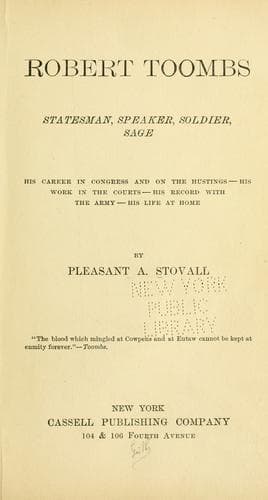
Robert Toombs: Statesman, Speaker, Soldier, SageStovall, Pleasant A.
History
Robert Toombs: Statesman, Speaker, Soldier, Sage
Stovall, Pleasant A.
Toombs, Robert Augustus, 1810-1885
In Augusta, in 1871, when he appeared before the Georgia Railroad
Commission and arraigned the lease of the State road as illegal and
unhallowed, he declared in a burst of indignation; "I would rather be
buried at the public expense than to leave a dirty shilling." It was the
acme of his desire to live and die like a gentleman.
He had always been a safe financier. Scorning wealth, he had early found
himself wealthy. It is estimated that he made more than a million
dollars by his law practice after the war. He spent his money freely,
careful always to avoid debt. Further than this, he kept no account of
his means. Like Astor, he invested much of his holdings in land, and
owned a large number of fine plantations in middle Georgia. When he died
his estate probably reached two hundred thousand dollars.
CHAPTER XXX.
HIS GREAT FAULT.
No just biography of Robert Toombs can be written that does not take
into notice the blemishes as well as the brightness of his character. He
was a man on a grand scale. His virtues were heroic, his faults were
conspicuous. No man despised hypocrisy more than he did, and no one
would have asked any sooner to be painted as he was, without
concealment. During the latter part of his life, many people knew him
principally by his faults. Few knew what the wayward Prince Hal of the
evening had been to King Henry in the morning hour. Like Webster and
Clay, he was made up of human frailty. As his intimate friend, Samuel
Barnett, said of him: "In spite of splendid physique, a man of blood and
passion, he was not only a model of domestic virtue, but he avoided the
lewd talk to which many prominent men are addicted. A fine sportsman and
rider, a splendid shot, he was nothing of the racer or gamester. After
all, he was more of a model than a warning." Among his faults, the one
which exaggerated all the others, was his use of ardent liquors. This
habit grew upon him, especially after the failure of the war. A proud,
imperious nature, accustomed to great labors and great responsibilities,
was left without its main resource and supplied with the stimulus of
wine. No man needed that stimulus less than he did. His was a manhood
vibrant in age with the warm blood of youth, and always at its best when
his spirits and intellect alone were at play. He was easily affected by
the smallest indulgence. When he measured himself with others, glass for
glass, the result was distressing, disastrous. The immediate effect of
excess was short. The next morning his splendid vitality asserted
itself, and he was bright and clear as ever. The habit, however, grew
upon him. The want of a physical check was bad. This was the worst of
all his faults, and was exaggerated by special circumstances. It was
less indulged in at home and greatly circulated abroad. Frequently the
press reporters would surround him and expose in the papers a mere
caricature of him. His talk, when under the influence of wine, was racy,
Public-domain text, read in full here on John Shaqi.
Reviews
Reviews
No reviews yet
Be the first to share your thoughts on this work.
Elsewhere in the archive
Join the Discussion
Join the discussion
Sign in to leave a comment or review.
Sign InorCreate an account