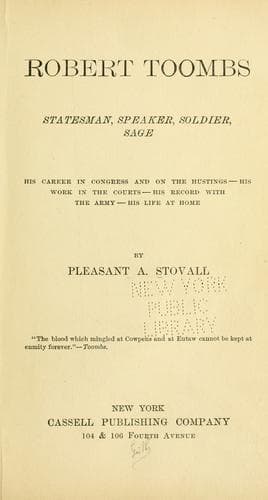
Robert Toombs: Statesman, Speaker, Soldier, SageStovall, Pleasant A.
History
Robert Toombs: Statesman, Speaker, Soldier, Sage
Stovall, Pleasant A.
Toombs, Robert Augustus, 1810-1885
extravagant, and fine, and his sayings too often found their way into
print. In this way great injustice was done to the life and character of
Robert Toombs, and Northern men who read these quaint sayings and
redolent vaporings formed a distorted idea of the man.
To a Northern correspondent who approached him during one of these
periods, General Toombs said: "Yes, a gentleman whose intelligence
revolts at usurpations must abstain from discussing the principles and
policies of your Federal government, or receive the kicks of crossroad
sputterers and press reporters; must either lie or be silent. They know
only how to brawl and scrawl 'hot-head' and 'impolitic maniac.' Why, my
free negroes know more than all your bosses. Now, damn it, put that in
your paper."
Robert Toombs was built to live ninety years, and to have been, at
Gladstone's age, a Gladstone in power. He took little pains to explain
his real nature. He seemed to take pains to conceal or mislead. He
appeared at times to hide his better and expose his worse side. If he
had been Byron, he would have put forward his deformed foot. He was
utterly indifferent to posthumous fame. Time and again he was asked to
have his letters and speeches compiled for print, but he would never
hear of it. He waived these suggestions away with the sententious
remark, "that his life was written on the pages of his country's
history." With all his faults, his were strong principles and generous
impulses. "We know something of what he yielded, but we know nothing of
what he resisted." Include his strength and his weakness and measure him
by other men, and we have a man of giant mold.
One who was very near to Toombs in his last days said of him when he was
dead: "It was a thing of sorrow to see this majestic old man pausing to
measure his poor strength with a confirmed habit, rising, struggling,
falling, and praying as he drifted on."
General Toombs used to say that Webster was the greatest man he ever
knew, that Clay managed men better, and Calhoun was the finest logician
of the century. "The two most eloquent men I ever heard were Northern
men," said he; "Choate and Prentiss." "Pierce," he used to say, "was the
most complete gentleman I ever saw in the White House. He was clever and
correct. Zachary Taylor was the most ignorant. It was amazing how little
he knew. Van Buren was shrewd rather than sagacious. Tyler was a
beautiful speaker, but Webster declared that a man who made a pretty
speech was fit for nothing else."
Public-domain text, read in full here on John Shaqi.
Reviews
Reviews
No reviews yet
Be the first to share your thoughts on this work.
Elsewhere in the archive
Join the Discussion
Join the discussion
Sign in to leave a comment or review.
Sign InorCreate an account